Friday, July 22, 2011

Trailer trash talk

I've been so apathetic about the Fright night 'reboot' (groooannn) that I hadn't noticed its trailer's been out for a while. Anyway, here it is:


Conspicuously absent from the trailer? Peter Vincent. Considering what they've done with the character, that's probably a good thing.

Now kids, I love the original. My interest in vampires was kicked off by its sequel, so, naturally, the originals hold a special place in my heart. I can buy that many of you younguns haven't seen either of 'em, or know they exist. YouTube comments like one from matthewsaidso, attest to that: 'This is like a vampire version of Disturbia. Thumbs up if you agree.'

Really? That's your point of comparison? I guess he didn't realise Disturbia (2007) is an obvious 'riff' (or rip, if you prefer) on Alfred Hitchcock's Rear window (1954) or the short story it's based on. Sure, a copyright claim was thrown out of court, but seriously, watch 'em back-to-back. You'll see.

But I digress. The original Fright night (1985), i.e. the proper one, was also obviously based on the same 'formula'. It was set in some sleepy Idaho town. This one's set in Vegas. Yes, that Vegas. Sigh. So much for subtlety. Goodbye small town terror.

Did I mention that 'Evil Ed' is played this-time-'round by Christopher Mintz-Plasse? You, know, McLovin from Superbad? Red Mist from Kick-ass? That guy? Yes. Yes I did. Oh man. Did you know it's also gonna be released in 3D? Why? Oh, right: inflated ticket prices. Ca-ching!

Anyway, another 'disturbing' thing I've noticed about the flick is this still:


Yep, that's Colin Farrell (Jerry Dandridge) ripping away Charley's cross, with it bursting into flame in his hand. I have a bias with this kinda stuff. I like my vampire lore and I like it when vampires fear the cross. If this is supposed to be an edgy rejection of the 'rules', well, it's a cliche in itself.

The original featured a neat twist on the idea: 'You have to have faith for that to work on me, Mr. Vincent.' I'm not sure if they're gonna use the same rule in this one. If not, deliberately inverting that 'rule' is nothing new. Anne Rice's Interview with the vampire (1976) popularised the modern vampire's disdain for religious items. Stephen King's 'Salem's Lot (1975) had already established the requirement of the cross-bearer's 'faith', ten years before Fright night was released.

It seems that most vamps these days have no problem with crosses, as mentioned in Bunson (1993) and Melton's (1994) respective vampire encyclopedias. Sometimes, filmmakers have resorted to monologues or dialogue that subvert most of the rules altogether. Here's a classic exchange between Jack Crow and Father Adam Guiteau in John Carpenter's Vampires (1998). A word of warning, though: some of this dialogue ain't PC or kid-friendly:
Jack Crow: You ever seen a vampire?
Father Adam Guiteau: No I haven't.
Jack Crow: No... Well first of all, they're not romatic. Its not like they're a bunch of fuckin' fags hoppin' around in rented formal wear and seducing everybody in sight with cheesy Euro-trash accents, all right? Forget whatever you've seen in the movies: they don't turn into bats, crosses don't work. Garlic? You wanna try garlic? You could stand there with garlic around your neck and one of these buggers will bend you fucking over and take a walk up your strada-chocolata WHILE he's suckin' the blood outta your neck, all right? And they don't sleep in coffins lined in taffata. You wanna kill one, you drive a wooden stake right through his fuckin' heart. Sunlight turns 'em into crispy critters.
Funny thing is, the novel the film was based on (John Steakley's Vampire$, 1990) isn't this extreme in removing the classic elements. The crosses do work, to an extent. Nor does its plot feature the vampires' pursuit of a cross (the Cross of Berseires), as it does in the flick.

Point is, the trope is nothing new. Neither is inverting it. It seems crosses are introduced into plots specifically so they can then be demonstrated as ineffectual by the vamps wearing, laughing at or crushing the things. Hell, even John Badham's Dracula (1979) features the Count yanking the cross out of someone's hand and setting it alight in his, so even that's a cliche. Therefore, the 'edginess' has been sucked right out of it.

Enough rambling for now. If you still wanna catch the flick, it'll be released on - hey, whaddya know. It's premiering here, in Oz, August 18. Also, Hungary.

It'll be released in the US, Canda and Poland the following day. For release dates in other countries, follow the link.

Thursday, July 21, 2011

Amazonian spending spree 2, pt. 1

I think it's pretty obvious that I love collecting non-fiction vampire books for my library. If I go without for a while, impulse kicks in and I go on a spree.


This time 'round, I beat my previous record and hit Amazon and Amazon.co.uk. Hard. Time for a peek at what I've been ordering and why. For this entry, I'll only be covering the ones that've arrived in the post. There's more on the way. I'm leaving out the shipping costs involved, as even a pedantic like me has limits.
Title: Reproductions of reproduction: imaging symbolic change (Routledge, 1996)
Author: Judith Roof
Date ordered: 11 July 2011
Date arrived: 19 July 2011
Price: GBP 8.94
Why'd I buy it? Superficial reasons, really. I read through a few interesting extracts on Google Books a while ago, and seeing as it was fairly cheap, I snapped up a copy. As it turns out, it has a whole chapter on vampires called, 'Unauthorized reproduction: vampires' uncanny metonymy', pp. 139-69. Sweet.

Title: Dracula (Oxford: Oxford University Press, 2011)
Author: Bram Stoker; edited with an introduction and notes by Roger Luckhurst
Date ordered: 8 July 2011
Date arrived: 20 July 2011
Price: £3.13
Why'd I buy it? Bought it for the introduction, baby. It was featured in an article Niels linked to on his blog, which instilled the temptation to buy the thing, wholesale. The discussion of the vampire's modernity got me hooked, because, as mentioned, I'm a big fan of that theory. Unfortunately, this niche interest is only given minor coverage (p. xv). D'oh! Still, at three quid: bargain. The rest of the intro looks pretty spiffy, too.

Title: The real Twilight: true stories of modern day vampires (London: John Blake, 2010)
Author: Arlene Russo
Date ordered: 8 July 2011
Date arrived: 20 July 2011
Price: £5.99
Why'd I buy it? Russo's previous book, Vampire nation (2005) was a breezy read, so I figured this would be more of the same. Little did I realise how much 'same' that would be. I turned the book's title page over, and what did I see in the publication info? 'First published in hardback as Vampire Nation in 2005'. Noooooooo! Redeeming virtue? 'This updated paperback edition published 2010'. Ooh... But then: 'Text copyright Arlene Russo 2005'. Noooooooo! It looks like the book was republished solely to cash in on the 'Twilight' name, especially as Vampire nation was already reprinted (under its original title) in 2008. It's got an awesome cover, at least.

Title: They bite: endless cravings of supernatural predators (Grand Rapids, Mich.: Citadel Press, 2009)
Author: Jonathan Maberry & David F. Kramer
Date ordered: 14 July 2011
Date arrived: 20 July 2011
Price: AUD 2.19
Why'd I buy it? Pretty sure I've glanced through this thing in Borders (R.I.P.) or Reader's Feast (soon to be R.I.P.). Wasn't expecting anything spectacular, but I did like the sidebars. I might've been a bit naive though, because the cover and title lead me to think the whole thing dealt with vampires. It doesn't (pp. 1-126) and a sizeable portion of that is made up of a 'species' dictionary of sorts (pp. 49-126). The rest of the book's concerned with 'hell hounds and monster dogs', 'werewolves and wolf-men', 'cryptids and the science of cryptozoology', 'the unquiet dead', 'hellfire and demons', 'tricksters and seducers' and 'a miscellany of monsters'.

Title: Vampire: Von damals bis(s) heute (Diedorf, Germany: Ubooks-Verlag, 2010)
Author: Nicolaus Equiamicus
Date ordered: 11 July 2011
Date arrived: 20 July 2011
Price: GBP 10.13
Why'd I buy it? This is a bit of a 'blame' Niels one. In a good way. I trust his judgement when it comes to vampire books and he's said some pretty good things about its author. It's in German (which I, of course, already knew), so I can't read the bloody thing, but presume it's instilled with its own inherent value. Who knows. Maybe someday I'll unlock its 'secrets'.
Stay tuned for the next thrilling instalment of 'Amazonian spending spree 2'! In the meantime, I'll keep an eye on the mailbox.

Thursday, July 14, 2011

Bugbears and Others

I added The BS historian to the 'Reading list' a coupla days ago, as the blog touches on a few issues pertinent to the field. Which ones? These...

Link
If there's anything I've learned from years of vampire research, it's that writings on the subject are rife with embellishment, misrepresentation, misinterpretation and flat-out lies. Now, you might be asking (depending on your poll choice), 'Hang on, vampires don't exist. It's not like it matters. They're imaginary.' To which I say, 'Maybe so. But you didn't make them up.'

When Rousseau wrote, 'There is not an historical fact in the world more fully attested, than that of the Vampires' (1763, p. 56), he wasn't kidding. Just to be clear, he wasn't upholding their reality, he was commenting on their status as a well-documented species. Regardless of one's personal beliefs on their 'existence', the vampire is as much a historical being - as portrayed by exhumation reports, folk beliefs and oral tales, etc. - as an 'imaginary' one. Proper respect needs to be given to their historical and cultural origins, ensuring they're represented accurately, without recourse to, well, making stuff up.

That's why I appreciate - and practice - the sceptical approach to texts in this field. It's a purgative (the reason why I called one of Elizabeth Miller's books an 'enema') approach in a field waist-deep in mud and dirt. Now, that doesn't mean I go around pooh-poohing the very idea of vampires themselves. That'd be almost redundant. No, I'm more interested in seeing whether what has been said about them is accurately relayed. You'd be surprised at how much speculation is presented as fact.

For instance, do you recall the Venetian 'vampire' unearthed in 2006? One major problem with that name: Venice has no extant vampire tradition. The whole case pretty much hinged on the skeleton of a woman in a plague pit found with a hunk o' brick in her mouth. This lead many to conclude that the item had originally been placed there as a method to prevent her feeding on the living. However, other explanations were possible, as the bshistorian recounts:
Yet another possibility, very relevant in this case, is some sort of prophylactic against the disease itself – sure, this woman was the only one in her mass plague pit grave to be so dealt with – yet lots of individuals in this Anglo-Saxon cemetery had stones in their mouths. A whole pit of vampires? Unlikely. Disease victims? More plausible. Or once again, were they punished criminals, or morally deficient in some way? We can’t really know. Nor can we with this Venice “Vampire”.
And that's the point. No need to automatically jump to that conclusion. I would also add that closer scrutiny should be given to the extant traditions in these locals. While debate continues over 'vampire's' etymology (see Kreuter 2006), we can at least agree that the tradition was centred in Slavic territories, as attested by its very name. However, it's generally accepted that the vampire is a universal tradition. To do so, however, a lotta wrangling's gotta be done over the definition of 'vampire'. The term, itself, however, applied to a specific type of revenant. This is also acknowledged by bshistorian:
One of the vampirologist’s (and indeed BS Historian’s) bugbears is the phenomenon of myth-creep. The more paranormal ideas are milked for their intellectual and commercial appeal, the more we see them distorted and modified to incorporate unrelated bits of history and folklore. In the case of the vampire it’s often an attempt to give it greater antiquity, presumably because the early 18th century isn’t far back enough for the first sightings of beings who we now think of as immortal. In fact that idea is itself a retrofit of a fictional, rather than folkloric attribute of the vampire.
LinkA word on 'the early 18th century' mention. Clearly, the era in which the vampire entered popular consciousness, is being alluded to here. However, there's precious little evidence that the tradition stretched much further back than that. Augustin Calmet, famous for his dissertations on vampires, made reference to the vampire's historicity:
In this age, a new scene presents itself to our eyes, and has done for about sixty years in Hungary, Moravia, Silesia, and Poland; men, it is said, who have been dead for several months, come back to earth, talk, walk, infest villages, ill use both men and beasts, suck the blood of their near relations, destroy their health, and finally cause their death; so that people can only save themselves from their dangerous visits and their hauntings, by exhuming them, impaling them, cutting off their heads, tearing out their hearts, or burning them. These are called by the name of oupires or vampires, that is to say, leeches; and such particulars are related of them, so singular, so detailed, and attended by such probable circumstances, and such judicial information, that one can hardly refuse to credit the belief which is held in those countries, that they come out of their tombs, and produce those effects which are proclaimed of them.
Antiquity certainly neither saw nor knew anything like it. Let us read through the histories of the Hebrews, the Egyptians, the Greeks, and the Latins; nothing approaching to it will be met with (1850 [1751], p. 2).
In this century, G. David Keyworth (2006) upheld Calmet's comments in his examination of vampire traits, by comparing them with other folkloric and legendary beings. He'd later expand his findings into a book (2007).

The attempts to give vampires a 'greater antiquity' for 'intellectual and commercial appeal' has been exploited in a variety of different ways. One of the obvious ones concern the popularity of vampire killing kits (VKK). That is, high-priced antiques sold off as genuine 19th century novelties. There are three things majorly wrong with this practice. Firstly, they're fake. Second, auctioneers present them as legit (which, in turn, can only cast a dim light on the profession, itself). Third, actual historical items are misrepresented - some, defaced - in the process of creating these kits.

The bshistorian has given brilliant coverage to the VKK 'industry' here, here, here, here, here and here. We need more blogs like that, not just in paranormal research, but in vampirology, too. It's one thing to enjoy vampires as entertainment, it's another to purposefully misrepresent their history and deceive others, to score a quick buck. So, my hat's off to BS!


References

Calmet, A, 1850 (1751), The phantom world: or, the philosophy of spirits, apparitions, & c., vol. 2, trans. H Christmas, Richard Bentley, London.

Keyworth, GD, 2006, ‘Was the vampire of the eighteenth century a unique type of undead-corpse?’, Folklore, vol. 117, no. 3, pp. 241–60.

Keyworth, [G]D, 2007, Troublesome corpses: vampires & revenants from antiquity to the present, Desert Island Books, Southend-on-Sea.

Kreuter, PM 2006, 'The name of the vampire: some reflections on current linguistic theories on the etymology of the word vampire', in P Day (ed.), Vampires: myths and metaphors of enduring evil, At the interface/probing the boundaries 28, Rodopi, Amsterdam, pp. 57–63.

Rousseau, JJ, 1763 (1762), An expostulatory letter from J.J. Rousseau, citizen of Geneva, to Christopher de Beaumont, Archbishop of Paris, London.

Tuesday, July 12, 2011

What's Been Going On and Upcoming Books on Vampire 3

Haven't been writing here much, as I've been busy with other things, namely research and going on a book-buying bender. Time for a catch-up and a peek at some forthcoming books I've stumbled across.

Firstly, it's great to hear that the guys behind the 2009 Vienna conference, 'Vampirismus und magia posthuma im Diskurs der Habsburgermonarchie im 18. und 19. Jahrhundert' are finally publishing their book. Got the scoop from Niels. It's currently available on pre-order. I've placed mine.

******************************

Speaking of Niels, his blog continues to blow my mind. Seriously, the guy just reels off his findings on obscure areas of vampiriana like they're nothing. If he's happy sharing that stuff publicly, I can't help wondering what secrets he isn't sharing. Sometimes, it makes me wanna throw in the towel. Some recent stand-outs include an overview of Zopf's famous vampire dissertation; uncovering sources for an obscure 'vampire' case; a source discussing magia posthuma in Poland, Hungary and Moravia; and debunking Stephen Hubner's 'vampire' status. Get your asses over there.

******************************


I rarely read vampire novles - or novels in general - but I have been reading Don Ecker's Past sins (Dark Realm Press, 2004). Let's say it ain't Twilight. If you're into your monstrous vamp (as I am), check it out. If you're one of them Kindle folk, click on the cover to buy a copy.

******************************


Speaking of buying things, I've found a few more books to add to the 'Upcoming books on vampires' collection. Stumbled across 'em while on the aforementioned book-buying bender.
Title: The theology of Dracula: reading the book of Stoker as sacred text
Author: Noël Montague-Étienne Rarignac
Release date: 19 July 2011 (Amazon); Spring/Summer 2011 (McFarland)
Worth the wait? Firstly, how fuckin' awesome is that cover? Seriously, look at it. Beautiful. As to the book itself, it's clearly one for the Dracula scholars. Another work focusing on literary interpretation, in this case, it 'represents a rereading of the horror classic as a Christian text, one that alchemizes Platonism, Gnosticism, Mariology and Christian resurrection in a tale that explores the grotesque' (McFarland's spiel). If that tickles your fancy, then it'll be the book for you. That said, I am interested in the religious overtones behind vampire texts, so it's definitely on my to-get list.

Title: Theorizing Twilight: essays on what’s at stake in a post-vampire world
Author: Maggie Parke & Natalie Wilson (eds)
Release date: 14 August 2011 (Amazon); Fall/Winter 2011 (McFarland)
Worth the wait? While I can barely repress a groan at another release dedicated to Twilight (I still have to give props to the saga for kickstarting the vampire boom, though), its publisher is a good indicator of quality. McFarland have an impressive track record when it comes to vampire stuff. Check out their vampire and Dracula titles.

Title: Vampires through the ages: lore & legends of the world's most notorious blood drinkers
Author: Brian Righi
Release date: 8 Janaury 2012
Worth the wait? While its title hits the mark in my preferred vampire niche ('lore & legends'), the 'notorious blood drinkers' angle makes me think the book's gonna give the same-old, same-old coverage to Elizabeth Bathory, John Haigh, Fritz Haarmann, et. al. Or, worse: Vlad Țepeș. Its comic book style cover doesn't exactly inspire me with confidence, either. I had a brief peek through Righi's Amazon oeuvre. Looks like he's into ghosts. Perhaps he'll view the subject through a paranormalist lens, which might be interesting. We'll see.
******************************

So, what have I been researching? Noneother than the Highgate vampire case. One element I've been pursuing is Highgate Cemetery's pre-1970 reputation for hauntings - vampiric or otherwise. There are certain texts which allude to to it, but don't seem to have been published before 1970 or the 1960s, which, of course, is highly suspicious. One stand-out's David Farrant's 'Invoking the vampire', New Witchcraft, vol. 1, no. 4, 1975, pp. 32–8:
Some interesting facts came to light. Firstly, it became apparent that stories of an apparition in Highgate cemetery had by no means begun with the then current sightings. Indeed, similar tales dated from the Victorian Era and interestingly enough more of them had "vampiristic" connections. One of the common tales of that time told of a "tall man dressed in black" who used to disappear mysteriously through the cemetery wall (p. 34).
In the same article, he also concluded, 'That Bram Stoker was influenced by the Highgate Vampire when he wrote "Dracula" . . . is almost certain' (ibid.). I've been asking Farrant how he obtained this information, i.e. 'oral tales, books, articles, whatever', over at The supernatural world forum. So far, I've been met with sidetracking, personal attacks, obscure allusions and the possibility that he might discuss them, if I explain my spiritual beliefs first - which I'd already done. Several times. Let's say I find it to be a highly unusual way to react to a simple request. Could we be dealing with a manufactured 'legend'? Quite possibly.

******************************

On a lighter note, I've been thinking of creating a new segment for this blog concerning beaut non-fiction vampire book covers. I occasionally express awe for them, so why not share a few which I think are particularly great? It's not set in stone, though. Just something I've been thinking of doing. See how it goes.

******************************

Last, but not least, don't forget to vote on the poll. There's only 10 days left, folks. Do you believe in vampires? Have your say today!

Friday, July 1, 2011

Getting Glut's book

I've finally got a first edition copy of Donald F. Glut's True vampires of history (1971), thanks to the magic of eBay.


I'd previously bought reprints of it by Castle Books (Secaucus, N.J.). However, I'm a stickler for first editions, so I had to find a copy of the HC Publishers, Inc. (New York) original.

How far did I go in my quest? I resorted to contacting its author. It was never that easy growing up, I'll tell ya. I sent him a cheque last year (Don doesn't 'do' PayPal), but it never arrived.

I got the urge to go trawling through eBay recently and lo, I serendipitously found a copy for US$9. This time, I doublechecked its publication info with the seller. After confirming a positive ident, I made an offer of five bucks. Not for the hell of it, mind you, but based on the book's condition:
Up for auction is a 1971 True Vampires of History Donald Glut Book. The paperback book is complete and nicely held together. The book has been in storage and it has rolling and warping from age. The pages and cover are yellowing. There is creasing at the corners of the cover and along the bottom of the back. The pages have rounded corners and a few have creases at the corners. The book also has creasing along the spine, and light wear and peeling around the edges. The book has 191 pages.
The seller accepted my offer. I purchased it on 16 June; it arrived on the 27th. Not bad. Incidentally, if you're interested in buying a copy of the book, feel free to contact Don. He'll probably even sign it for you, if you ask nicely. I would've gotten my copy from him, if there wasn't that hassle with the cheque. However, if you're a US resident, you probably won't encounter the same problem I did.

Thursday, May 12, 2011

Lindsay Lohan, Vampire

I don't know why I'm even bothering to share the following image. Maybe it's because I've been reading about her in the last coupla days. Nonetheless, it's certainly an indication of how mainstream vamps have become.


Yep, that's Lindsay Lohan straddling The vampire diaries' Michael Trevino. Even though she's wielding a stake, she's actually the vampire in the piece. But it does get weirder.

According to Radar Online, A. J. McLean of Backstreet Boys fame, 'paid between $30,000 and $40,000 for the large print'. For the picture's context and 'meaning', we turn to photographer Tyler Shields' blog. Here's the scoop: 'Lindsay and I had been wanting to do this vampire shoot for a while and it came together in perfect time for my gallery, Trevino just happened to be in town it was all meant to be!' Ok then.

Upcoming Books on Vampires 2: The New Batch

Been a while since I've done this segment. Time to share some forthcoming vampire books I've stumbled across via the the American, British, German and French versions of Amazon.


I've also translated the non-English titles with this baby. So, forgive me if they're a lil wonky. Without further ado and in chronological and alphabetical order by release date...
Title: Bringing light to Twilight: perspectives on a pop culture phenomenon
Author: Giselle Liza Anatol (ed.)
Release date: 24 May 2011
Worth the wait? The Twilight bandwagon keeps on a-rollin', as shown by this latest collection of essays devoted to Meyer's astoundingly successful saga. If you're not a fan, I'm sure something on vamps, in general, could be gleaned from its pages. I do like the idea of examining the works from the perspective of a pop culture phenomenon, though.

Title: V is for vampire: an illustrated alphabet of the undead
Author: Adam-Troy Castro; illustrated by Johnny Atomic
Release date: 7 June 2011
Worth the wait? When I first came across this book, I thought it'd be another entry in my beloved vampire reference book genre, like J. Gordon Melton's The vampire book: encyclopedia of the undead (1994; 1999; 2011). Its title even echoes David J. Skal's V is for vampire: the a-z guide to everything undead (1996). Alas, it appears to be little more than a portfolio, going by its product description. I know I'm cheating by including an under-100-pages book in this segment, but damn, it's got a pretty sweet cover.

Title: Der sympathische Vampir: Visualisierungen von Männlichkeiten in der TV-Serie Buffy (The sympathetic vampire: visualizations of masculinity in the TV series Buffy)
Author: Marcus Recht
Release date: 11 July 2011
Worth the wait? The title pretty much speaks for itself, doesn't it? Talk about specific, too! Recht's set himself up with quite a challenge by devoting 340 pages to that oblique topic, so kudos for effort!

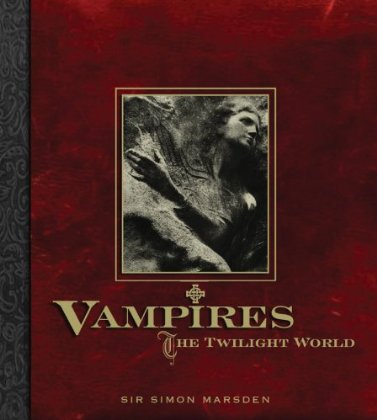
Title: Vampires: the twilight world
Author: Simon Marsden
Release date: 6 October 2011
Worth the wait? I was pleasantly surprised to see Marsden's gonna be contributing a volume on vamps, even if his title's an obvious riff on Stephenie Meyer's well-known saga. He's my favourite photographer and I grew up on his other works like Phantom of the Isles: further tales from the Haunted Realm (1990) and The journal of a ghosthunter: in search of the undead from Ireland to Transylvania (1994). That said, don't expect too much scholarship from his work. You buy (or borrow) the books for the stories and awesome pics. Have a browse through his stuff. You'll see what I mean. Hopefully this book's packed with new stuff and not just a 'compilation' of sorts.

Title: Blut ist ein besonderer Saft: Eine Kulturgeschichte der Vampire (Blood is a special liquid: a cultural history of vampires)
Author: Leah Levine
Release date: 15 November 2011
Worth the wait? Yes, blood certainly is a 'special liquid'. I like the 'cultural history of vampires' angle, but I wonder how much justice it'd be given over the course of 180 pages. I'm not familiar with any of Ms. Levine's other works, so I've got no context to give ya. However, Niels does, not only noting that the book will actually be published in May (the November copy's the only one I saw on Amazon.de), but that 'Amazon describes the author as a well-known German witch and a founder of a school for witches in Hannover!' I'm guessing he's worried about an occultic angle potentially 'ruining' the scholarly potential of the subject matter.

Title: True blood: vampires and Southern Gothic
Author: Brigid Cherry
Release date: May 2012
Worth the wait? A contribution to the 'Investigating cult TV series' series, which I know nothing about, this looks like it might be one of those philosophy books dedicated to mainstream pop culture franchises. Two, off the top of my head, which focus on HBO's True blood are True blood and philosophy: we wanna think bad things with you and A taste of true blood: the fangbanger's guide (both 2010).

Title: Screening the undead: vampires and zombies in film and television
Author: Leon Hunt, Sharon Lockyer & Milly Williamson
Release date: December 2012
Worth the Wait? It's amazing how 'advanced' Amazon.co.uk's publishing schedule is, isn't it? As to the book itself, I don't immediately recognise Leon and Sharon from anywhere, but I am familiar with Milly's The lure of the vampire: gender, fiction and fandom from Bram Stoker to Buffy (2005). Whether it'll focus on these relatively narrow facets, I can't say. Going by the title - which is about all I can do right now - it sounds like a fairly generic (albeit academic) run-through of the undead genre. However, due to Milly's participation, it could have some merit.
And that concludes this segment. Now, I know I've limited my scope just by focusing on the stuff featured on Amazon, especially when works like Daniel J. Wood's Realm of the vampire (2011) aren't featured in its contents. So, if any of you other publishers out there want to 'broadcast' your books, feel free to e-mail me. But remember, they've gotta be non-fiction works on vampires.
Related Posts with Thumbnails

News