Showing posts with label Christopher Frayling. Show all posts

Wednesday, October 6, 2010

Round-Up Time

Just a few items concerning vampire-related things in my life at the moment. We start off with my pursuit of Montague Summers, an eBay purchase, a rambling (brief) film review and giving props to Amazon.

I've gotten onto a bit of a Montague Summers (1880-1948) kick. A very prolific writer, best known in vampire studies for writing The Vampire: His Kith and Kin (1928) and its companion tome, The Vampire in Europe (1929). Even though he only wrote these two books in the genre, their impact was massive. Indeed, you'll still find them in print today. He's even spawned a blatant imitator.

Anyhoo, I've been looking for biographical info on the guy, so I ordered two books about him through interlibrary loan. Borrowed both of 'em, yesterday. They are Timothy D'Arch Smith's The Books of the Beast: Essays on Aleister Crowley, Montague Summers, Francis Barrett and Others (Crucible, 1987) and Frederick S. Frank's Montague Summers: A Bibliographic Portrait (Metuchen: The Scarecrow Press, 1988).

I was, quite frankly, disappointed with both. Not with their content, though. You see, I was expecting primarily original material from both, but, alas, they're essentially anthologies of previously published material. D'Arch Smith's book has two essays on Summers: "Montague Summers" (51-57) and "R. A. Caton, Montague Summers, and The Fortune Press" (58-74).

The first essay (presumably published with the second), is reproduced from his 1984 booklet, Montague Summers: A Talk (Edinburgh: Trargara Press). The preface mispells this as "Trargars".

One section of the book did startle me, though: the confirmation that Summers participated in a Black Mass on 26 December, 1918 (56-57). As to one of the other rumours swirling about Summers, the pederasty coverage is relatively hazy, but plausible enough to feel quite disconcerting.

Frank's book is indeed a "bibliographic portrait", consisting of a stack of content mainly reproduced from Summers' own works. The essays that comprise the first part of the book (3-34) have all been published elsewhere. However, the bibliographic chronology and annotated bibliography (156-246) seem to be unique to the book. So, props for that.

I know these might sound like harsh assessements, but just to clarify, these books certainly possess high value for those digging up info on Summers. The harshness is merely one of personal taste. I am keen on original material, you see. First editions. Items as close to a primary source as possible. The books are valuable in that they collate some pretty rare stuff into a solid whole. So, yes, I still recommend them. Personally, though, it means I gotta track down the original sources. At least I've got leads to work with!

*****************************

Speaking of original prints, Christopher Frayling's Vampyres: Lord Byron to Count Dracula (London: Faber and Faber, 1991) arrived in the mail today. I purchased the item from eBay on the 26th of September for GBP 4.99 (after requesting a markdown from 7.99). Quite a bargain.


I already own the paperback edition, which was published the following year. But, I just had to add this '91 hardback to my collection. Incidentally, it's a revised edition of Frayling's The Vampyre: Lord Ruthven to Count Dracula (1978). That one's on my of to-gets, too.

*****************************

Watched Suck (2009) on DVD today. Although the title's probably ironic, it's not far from the truth. It features a swathe of cameos, namely Henry Rollins, Alice Cooper, Moby, Iggy Pop, Henry Rollins, hell, even Alex Lifeson from Rush. As you might've gathered, it's a vampire rock 'n' roll flick. But the music was pretty average and none of those aforementioned musos actually sing in the movie.

It's a bit of an odd flick, incorporating stop motion and dramatic lighting during various scenes. And, I gotta admit, Dimitri Coats made a pretty damn effective vampire...despite his dodgy clothes. I just felt that the flick ran out of steam once the band (The Winners) hit the US border. Just kind've ambled along at that point. It certainly has some clever moments, like the flashback scenes for Malcolm McDowell's vampire hunter. Rather than make him look young or hire a younger actor to play him, the director deftly integrated footage from an actual young McDowell. Nice touch.

I'm also savvy enough to know that the director reproduced a few classic album covers in his shots, namely The Beatles' Abbey Road, Bruce Springsteen's Born in the U.S.A., The Who's The Kids are Alright and T. Rex's Electric Warrior. While quietly amusing at first, it got a bit repetitive, real quick. Didn't really fit the narrative, either. And speaking of "quietly amusing", I don't think I even laughed once during the film. It's a horror comedy. Seemed too limp for that. That said, it was vaguely entertaining. Probably needed a faster pace.

*****************************

The problems I had with Day's book (mentioned here), were fixed up shortly after I wrote that blog entry. I requested a partial refund (half of the total price), as I was still gonna keep the book, which they granted. Kudos, Amazon, for swiftly stitching that up.

Tuesday, January 12, 2010

Title and Cover Variations

When vampire books are translated into other languages, their covers and titles can vary quite drastically.

Here's an example I came across on eBay:


It is a retitled Spanish edition, called Los vampiros aun existen ("Vampires Still Do Exist"), of a popular American work on the subject. See if you can guess which one.

Give up?

Look no further than Konstantinos' Vampires: The Occult Truth (St. Paul, MN: Llewellyn, 1996):


This process sometimes occurs even in English language works for British and American markets. For instance, Gabriel Ronay's The Dracula Myth (1972) is more commonly known by its American retitling, The Truth about Dracula (1972) and Christopher Frayling's The Vampyre: Lord Ruthven to Count Dracula (1978) was published in the US as Vampyre: A Bedside Companion (1978).

Thursday, January 8, 2009

Frayling's "Vampire" Makes Another Appearance

I've just read Taliesin's "From Demons to Dracula - review", which cites this very blog:
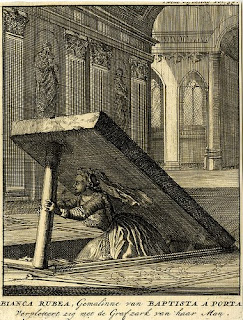
My caution with regards the book started small, there were just the occasional areas that gave me pause for thought and I could actually understand why they occurred. There is an illustration in the introduction, page 12, of “‘a vampire rises from the grave…’in an 18th century illustration” . Actually, not long before receiving the book (as a Christmas present from my ever loving wife) I read an article about this illustration on the blog Diary of an Amateur Vampirologist. It seems the illustration was reproduced in Frayling’s Vampyres: Lord Byron to Count Dracula (listed in the bibliography of this) as such a piece, but it is actually of "BIANCA RUBEA, wife of BAPTISTA Á PORTA / crushes herself with the tombstone of her husband." A minor problem, as it is an illustration of a suicide and not a vampire, but I can see why Beresford believed it to be of a vampire given Frayling used it as such.
I most recently dealt with this erroneously-named picture in "Hats Off to Erwin".

Taliesin also left a comment to said blog, which I'll reply to here:
I am currently reading "From Demons to Dracula" by Matthew Beresford, which so far is quite good - expect a review when read.
As mentioned, I did read it. Loved it. If you're interested, you might want to check out Niels K. Petersen's coverage of it over at Magia Posthuma.

I'm sure I'll get around to obtaining a copy of the book, sometime, myself.
However, the illustration is reproduced in that with the caption "A vampire rises from the grave, from an eighteenth century illustration."
Ah, yes. Nearly the exact same caption it's given in Frayling's book, Vampyres: From Lord Byron to Count Dracula (1991).
It accompanioes the introduction. Now, given Beresford cites Frayling in his bibliography, the place he picked it from is clear but, it seems, this one is likely to run and run...
I'd agree that Frayling's book is the most likely source for the picture's erroneous description. The obvious clue to this is the caption that follows it in Frayling's work: "A vampire rises from the grave, illustrating an early eighteenth century treatise on the undead."

A slightly different wording to that found in Beresford's book, as you've quoted it, but recognisable, nonetheless.

I certainly hope it doesn't catch on as a picture representing an undead rising from the tomb. Though, there is certainly an irony in that description, considering that it actually depicts a woman entombing herself, certainly not rising in search of blood.

So folks, if you see this picture (chances are, with the original caption removed)...


...being referred to as anything even remotely vampiric, then dismiss it as bad research. Indeed, it's not even from the "eighteenth century", but the seventeenth. For, according to the Koninklijke Bibliotheek, the image was published in 1699.

Tuesday, December 9, 2008

Hats Off to Erwin

I was rather pleased to see a comment left on one of my posts, recently.

Although, I was a tad alarmed at the message itself:
It seems that the picture a woman killing herself by being crushed by her husband's tombstone. That's what the caption says in Dutch.
See: http://www.flickr.com/photos/kintzertorium/3090689838/
Taken out of context (and keeping in mind, that I didn't immediately see which post it had been submitted to, before approving it for publication), it seemed irrelevant to this blog.

That is, until I viewed the link. For curiousity's sake, of course.

And boy, did that pay off!

The link in question leads to a certain image dealt with in "Bad Captions" and "A Note on Bad Captions". Except, it appears to be a scan of the original image!

You might remember that in Frayling's book, a reproduction of the image was captioned:
A vampire rises from the grave, illustrating an early eighteenth century treatise on the undead.
Fortunately, the owner of the Flickr account (Kintzertorium) has retained the original's caption, which appears to read:
BIANCA RUBEA, Gemalinne van BAPTISTA Á PORTA Verplenert zig met de Graf zark van haar Man.
A commentator on the image, by the name of groenling, has even translated the caption into English:
"BIANCA RUBEA [her maiden name, I assume], wife of BAPTISTA Á PORTA / crushes herself with the tombstone of her husband."
At this point, I think it's fairly safe to say that the image does not depict a vampire.

The question is, who's responsible for mislabeling it in that manner?

The author? The publisher? The designer?

Now that'll be interesting to find out...

Oh, and Erwin, if you're reading: I really appreciated that link! Much appreciated indeed!

Monday, August 4, 2008

A Note on Bad Captions

I know it seems much ado about nothing, but I'm delving into this matter further. But the way I see it, it's the bricks that make the house.

In the previous installment of this saga, I talked about a seeming discrepancy regarding a caption for a picture found in Christopher Frayling's Vampyres: Lord Byron to Count Dracula (London: Faber and Faber, 1992).

The book that seems to have inspired its inclusion in Frayling's book, was Ornella Volta's French book,
Le Vampire: La Mort, le Sang, la Peur (Paris: Jean-Jaques Pauvert Éditeur, 1962). I also quoted Frayling's "Bibliography and Acknowledgments" to this effect.

However, some eagle-eyed readers might have noticed that the quote that I gave seems to refer to an Italian edition:

On the erotic angle, Ornella Volta's Il Vampiro (1962) is interesting (if a little strange at times) and has some extraordinary illustrations (p. 424)

There was an Italian edition by this name. However, it wasn't published until 1964. See: "Il Vampiro", Il Catafalco - L'avello dei vampiri.

This leaves us with two possibilities: either Frayling got the date of the book wrong or he got the name of the book wrong. Unfortunately, we have little to go on, because Frayling's "Bibliography..." is surprisingly bereft of bibliographic detail. I'm reminded of the atrocious (though not to put Frayling in the same league) bibliography featured in Dudley Wright's famous work, Vampires and Vampirism (1914; 2nd edn. 1924).

Even Montague Summers was moved to comment on it in his "Introduction" to The Vampire: His Kith and Kin (London: Kegan Paul, Trench, Trubner & Co., Ltd., 1928):

In the Bibliography we have such entries as "Leo Allatius," "Encyclopaedia Britannica" ; "Frazer's Golden Bough," "Nider's Formicarius," "Phlegon's Fragments," "William of Newbury," all of which are not merely unscholarly and slovenly, but entirely useless from the point of view of reference. (p. xii)

Couldn't agree more.

That said, Frayling's book (and yes, his Bibliography too) certainly make a compelling read. In fact, it might even surprise you to know that it's one of my favourite works on vampires.

That doesn't mean it should be spared from criticism, of course. Indeed, Frayling has no qualms dishing it out himself in the same book:

On vampirism in general Montague Summers's two books, The Vampire: His Kith and Kin (1928) and The Vampire in Europe (1929), and Dudley Wright's Vampires and Vampires (1914) are unreliable and have for too long been treated as gospel. (p. 424)

This fuss about captions also has a deeper undercurrent.

You see, finding 18th century images depicting vampires is quite a difficult task. In fact, I haven't been able to find any such image, thus far. It's possible that vampires were never depicted in that era, via illustration.

Therefore, it's a blight on academic pursuits into the field to misrepresent pictures in such a way.

Friday, August 1, 2008

Bad Captions

Yesterday, I was in the Rare Books Collection reading room at Monash University Library (Clayton), having a browse through Ornella Volta's Le Vampire: La Mort, le Sang, la Peur (Paris: Jean-Jaques Pauvert Éditeur, 1962).

When I came to page 26, I noticed a picture I had seen elsewhere.

I immediately thought of a plate (3) in Christopher Frayling's Vampyres: Lord Byron to Count Dracula (London: Faber and Faber, 1992).

The difference, however, is in the way they're captioned.

In Volta's book, the image is credited thusly:

Jan Luiken : Bianca Rubea, 1711.
Coll. Henry Kahnweiler

Meanwhile, Frayling's version reads:

A vampire rises from the grave, illustrating an early eighteenth century treatise on the undead.

And sure enough, if we turn to Frayling's "Bibliography and Acknowledgements", we get a reference to a certain source consulted for his book:

On the erotic angle, Ornella Volta's Il Vampiro (1962) is interesting (if a little strange at times) and has some extraordinary illustrations (p. 424)

However, the riddle doesn't quite end there.

I thought it'd be easy to trace Bianca Rubea as a novel. Thus far, I haven't been able to trace anything by that name.

I've been able to track down Luiken (or Luyken, 1649-1712) easily enough, though. Turns out he was a Dutch engraver. But the only books I've been able to turn up, that fit the year Volta's caption gives (1711), are: De bykorf des gemoeds and Het leerzaam huisraad.[1]

Rest assured, these are
not treatises of the "undead". Indeed, Luiken never illustrated any such treatise.

Looks like Faber and Faber and Frayling tried to pull the wool over our eyes!

[1] "Jan Luyken". DBNL auteur. 1 August 2008.

Related Posts with Thumbnails

News