Friday, July 1, 2011

Getting Glut's book

I've finally got a first edition copy of Donald F. Glut's True vampires of history (1971), thanks to the magic of eBay.


I'd previously bought reprints of it by Castle Books (Secaucus, N.J.). However, I'm a stickler for first editions, so I had to find a copy of the HC Publishers, Inc. (New York) original.

How far did I go in my quest? I resorted to contacting its author. It was never that easy growing up, I'll tell ya. I sent him a cheque last year (Don doesn't 'do' PayPal), but it never arrived.

I got the urge to go trawling through eBay recently and lo, I serendipitously found a copy for US$9. This time, I doublechecked its publication info with the seller. After confirming a positive ident, I made an offer of five bucks. Not for the hell of it, mind you, but based on the book's condition:
Up for auction is a 1971 True Vampires of History Donald Glut Book. The paperback book is complete and nicely held together. The book has been in storage and it has rolling and warping from age. The pages and cover are yellowing. There is creasing at the corners of the cover and along the bottom of the back. The pages have rounded corners and a few have creases at the corners. The book also has creasing along the spine, and light wear and peeling around the edges. The book has 191 pages.
The seller accepted my offer. I purchased it on 16 June; it arrived on the 27th. Not bad. Incidentally, if you're interested in buying a copy of the book, feel free to contact Don. He'll probably even sign it for you, if you ask nicely. I would've gotten my copy from him, if there wasn't that hassle with the cheque. However, if you're a US resident, you probably won't encounter the same problem I did.

Thursday, May 12, 2011

Lindsay Lohan, Vampire

I don't know why I'm even bothering to share the following image. Maybe it's because I've been reading about her in the last coupla days. Nonetheless, it's certainly an indication of how mainstream vamps have become.


Yep, that's Lindsay Lohan straddling The vampire diaries' Michael Trevino. Even though she's wielding a stake, she's actually the vampire in the piece. But it does get weirder.

According to Radar Online, A. J. McLean of Backstreet Boys fame, 'paid between $30,000 and $40,000 for the large print'. For the picture's context and 'meaning', we turn to photographer Tyler Shields' blog. Here's the scoop: 'Lindsay and I had been wanting to do this vampire shoot for a while and it came together in perfect time for my gallery, Trevino just happened to be in town it was all meant to be!' Ok then.

Upcoming Books on Vampires 2: The New Batch

Been a while since I've done this segment. Time to share some forthcoming vampire books I've stumbled across via the the American, British, German and French versions of Amazon.


I've also translated the non-English titles with this baby. So, forgive me if they're a lil wonky. Without further ado and in chronological and alphabetical order by release date...
Title: Bringing light to Twilight: perspectives on a pop culture phenomenon
Author: Giselle Liza Anatol (ed.)
Release date: 24 May 2011
Worth the wait? The Twilight bandwagon keeps on a-rollin', as shown by this latest collection of essays devoted to Meyer's astoundingly successful saga. If you're not a fan, I'm sure something on vamps, in general, could be gleaned from its pages. I do like the idea of examining the works from the perspective of a pop culture phenomenon, though.

Title: V is for vampire: an illustrated alphabet of the undead
Author: Adam-Troy Castro; illustrated by Johnny Atomic
Release date: 7 June 2011
Worth the wait? When I first came across this book, I thought it'd be another entry in my beloved vampire reference book genre, like J. Gordon Melton's The vampire book: encyclopedia of the undead (1994; 1999; 2011). Its title even echoes David J. Skal's V is for vampire: the a-z guide to everything undead (1996). Alas, it appears to be little more than a portfolio, going by its product description. I know I'm cheating by including an under-100-pages book in this segment, but damn, it's got a pretty sweet cover.

Title: Der sympathische Vampir: Visualisierungen von Männlichkeiten in der TV-Serie Buffy (The sympathetic vampire: visualizations of masculinity in the TV series Buffy)
Author: Marcus Recht
Release date: 11 July 2011
Worth the wait? The title pretty much speaks for itself, doesn't it? Talk about specific, too! Recht's set himself up with quite a challenge by devoting 340 pages to that oblique topic, so kudos for effort!

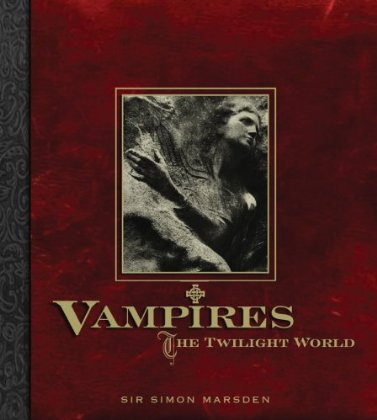
Title: Vampires: the twilight world
Author: Simon Marsden
Release date: 6 October 2011
Worth the wait? I was pleasantly surprised to see Marsden's gonna be contributing a volume on vamps, even if his title's an obvious riff on Stephenie Meyer's well-known saga. He's my favourite photographer and I grew up on his other works like Phantom of the Isles: further tales from the Haunted Realm (1990) and The journal of a ghosthunter: in search of the undead from Ireland to Transylvania (1994). That said, don't expect too much scholarship from his work. You buy (or borrow) the books for the stories and awesome pics. Have a browse through his stuff. You'll see what I mean. Hopefully this book's packed with new stuff and not just a 'compilation' of sorts.

Title: Blut ist ein besonderer Saft: Eine Kulturgeschichte der Vampire (Blood is a special liquid: a cultural history of vampires)
Author: Leah Levine
Release date: 15 November 2011
Worth the wait? Yes, blood certainly is a 'special liquid'. I like the 'cultural history of vampires' angle, but I wonder how much justice it'd be given over the course of 180 pages. I'm not familiar with any of Ms. Levine's other works, so I've got no context to give ya. However, Niels does, not only noting that the book will actually be published in May (the November copy's the only one I saw on Amazon.de), but that 'Amazon describes the author as a well-known German witch and a founder of a school for witches in Hannover!' I'm guessing he's worried about an occultic angle potentially 'ruining' the scholarly potential of the subject matter.

Title: True blood: vampires and Southern Gothic
Author: Brigid Cherry
Release date: May 2012
Worth the wait? A contribution to the 'Investigating cult TV series' series, which I know nothing about, this looks like it might be one of those philosophy books dedicated to mainstream pop culture franchises. Two, off the top of my head, which focus on HBO's True blood are True blood and philosophy: we wanna think bad things with you and A taste of true blood: the fangbanger's guide (both 2010).

Title: Screening the undead: vampires and zombies in film and television
Author: Leon Hunt, Sharon Lockyer & Milly Williamson
Release date: December 2012
Worth the Wait? It's amazing how 'advanced' Amazon.co.uk's publishing schedule is, isn't it? As to the book itself, I don't immediately recognise Leon and Sharon from anywhere, but I am familiar with Milly's The lure of the vampire: gender, fiction and fandom from Bram Stoker to Buffy (2005). Whether it'll focus on these relatively narrow facets, I can't say. Going by the title - which is about all I can do right now - it sounds like a fairly generic (albeit academic) run-through of the undead genre. However, due to Milly's participation, it could have some merit.
And that concludes this segment. Now, I know I've limited my scope just by focusing on the stuff featured on Amazon, especially when works like Daniel J. Wood's Realm of the vampire (2011) aren't featured in its contents. So, if any of you other publishers out there want to 'broadcast' your books, feel free to e-mail me. But remember, they've gotta be non-fiction works on vampires.

Tuesday, May 10, 2011

Catch-Up Time

It's been a bit quiet since my previous rant, so time to fill the void with a few random updates on what's been happening since.

Finished reading Daniel J. Wood's Realm of the vampire: history and the undead (2011), which I'll be reviewing soon enough. The extent of the sources used for his book certainly made my rant worthwhile. Strangely, it appears to be available from only one source. Hopefully, it'll receive wider distribution, as it covers a largely neglected aspect of vampire folklore.

******************************

Speaking of vampire folklore, it's great to see Niels went ahead and purchased Daniela Soloviova-Horvilla's Les vampires : Du folklore slave à la littérature occidentale after I drew his attention to it. Better yet, he described it as looking 'very, very promising'. From him, that's high praise indeed. Hopefully, it pays off.

He also notes 'Soloviova-Horvilla herself has a background in Bulgaria which provides her with a working knowledge of the languages pertinent to the Slavic vampire' and 'her work obviously draws on a number of sources otherwise not easily available to Western scholars', which touches on the basis of my rant: we're seriously deprived in terms of non-English resources on the undead. This is especially pertinent considering that the vampire myth essentially has its basis in Slavic regions. Notably few English language authors tap into these resources, barring, of course, guys like Jan L. Perkowski and Bruce A. McClelland.

******************************

Came across an interview with Theresa Cheung, author of The Element encyclopedia of vampires (2009) which I've discussed before. She expresses a remarkably open-minded view on the existence of vampires which, if I might be snarky for a moment, could explain her susceptibility to the FVZA's claims.

******************************

I dunno if it's apparent in my blog, but I'm a fan of the vampire's 'modernity' in terms of its depiction in folklore and don't really buy into the 'universality' of the vampire mythos. So, it's great to see Niels giving this angle some coverage, also including Toby Lichtig well-researched review. Indeed, the discussion of Roger Luckhurst's notes to the Oxford World's Classics' edition of Dracula is seriously tempting me to buy a copy.

******************************


Yesterday, my eBay-purchased copy of Vampiri: miti, leggende, letteratura, cinema, fumetti, multimedialità (1998) arrived in the mail (bought on the 22nd). Can't say much about its contents, as my Italian is piss-weak, but I was surprised to discover it's actually a non-fiction vampire anthology. That makes it a bit of a rarity in its own right. Lots of pretty pictures, too.

******************************

I like the formatting and layout of my WordPress blog so much, that I'm thinking of creating an offshoot to this one. But never fear: I won't be shutting down this one. Either way, it's just a thought. Nothing set in stone. Yet. We'll see how it goes.

Wednesday, April 27, 2011

Prospective Publishers, Take Note!

I've noticed my tendency to go on little rants about the lack of 'access' we English as Only Language (EOL) folk have to foreign language material on vampires. Time for another one!

I loves my vampire folklore. Can't get enough of it. Unfortunately, it's often overlooked - or briefly covered - in favour of cinematic and literary treatments of the vampire genre. As I've mentioned before, the Library of Congress features 110 listings in its vampires in literature subject category, alone. Major works on vampire folklore in English are largely covered by Montague Summers, Paul Barber, Jan L. Perkowski, Bruce A. McClelland and Theresa Bane. Even then, their works provide a tantalising insight into what we EOLers are missing out on (not to detract from the brilliance of their writings).

Fer instance, flip your way through the 'Théses & Livres Culturels' tag in Lady Nini's blog, Livres de Vampires. Look at that stuff! I doubt it's all gold, but there's gotta be a lotta great, untapped info there. I even stumbled upon a recently published work dedicated to vampire folklore: Daniela Soloviova-Horville's Les vampires : du folklore slave à la littérature occidentale (2011).

And of all the stuff written in French on the subject, I can only think of books that've been translated into English: Ornella Volta's Le vampire : la mort, le sang, la peur (1962; The vampire, 1965), Jean Marigny's Sang pour sang : le réveil des vampires (1993; Vampires: the world of the undead, 1994) and Claude Lecouteux's Histoire des vampires : autopsie d'un mythe (1999; The secret history of vampires: their multiple forms and hidden purposes, 2010).

Five, if we're including the 1749 and 1850 translations of Calmet's work. That's it.

'Hang on a second!' some of you particularly well-read readers might interject. 'Wasn't Pëtr Bogatyrëv's Vampires in the Carpathians originally written in French?' Well, yeah. But keeping with the tradition of compulsively retitling the other French works, looks can be deceiving: that particular book had almost bugger-all to do with vampires.

With German works, we're even worse off: I can't think of any English translations. The tragedy of that situations becomes readily apparent when you realise that the early writings on the subject were primarily written in German (and Latin, to be fair). As was the first full-length literary study: Stefan Hock's Die Vampyrsagen und ihre Verwertung in der deutschen Litteratur (1900).

That's why I was exhilarated to hear about an upcoming English work by one of Germay's foremost vampire scholars, Peter Mario Kreuter. They're so ahead of us, that some of 'em are even starting to delve into obscure facets of the non-fiction vampire genre. Like, for example, vampirology's relation to librarianship.


I was so excited to hear about it, that I went ahead and ordered a copy of the book on eBay, even though I won't be able to read the bloody thing. Niels' gave it a pretty positive review, at least. Phew.

So, publishers, if you're reading, instead of palming off the usual guff, how about focusing on translating instead? The genre would be enriched by an influx of 'new' information and the doorway would open to readers who probably aren't familiar with the foreign language stuff, encumbered, as we are, by our linguistic limitations.

Wednesday, April 6, 2011

Andy Responds!

I'm so glad I cautiously-worded my coverage of certain obscure vampire lore in one of Andy's movie reviews.


We're talking about the nailing-the-vampire-through-the-head thing as a means of 'destroying' an undead. I said that he 'may or may not know' that it had a 'European precedent'. Turns out, he did know (I shoulda known he would). Here's his reply:
Hi Anthony, good article.

I was aware of the European lore - especially via Calmet. I also take the point that the filmmakers were likely looking to European lore rather than anything further flung.

The fault is mine for not explaining what I meant. I was more alluding to an accidental connectivity, perhaps alluding to a subconscious undercurrent.

Why was a stake or a nail used? To pin the undead to the floor primarily (or in Indonesia to strip them of their powers, essentially the same thing).

This would allow for a generally common theme (and possibly sources back to post-mortem sitting of corpses, which I understand is more common than we'd think)

I like such connections and perhaps should have mentioned the, clearly, more obvious European connection.

Re your quote concerning the location of the nail (ie back of the neck), this is a more common entry point (from my researches), but at least one Indonesian films switches things to the crown of the skull. The forehead makes for a more visually immediate scene, when the corpse is coffin bound ;)
All good points and I like that Andy's openly discussing his interest in comparative folklore; a common theme in vampire studies.

Friday, April 1, 2011

Head Like a Hole

An obscure method of destryoing vampires caught my attention in Andrew's review of The night of the walking dead (1977).


Andrew has a great passion for the lore featured in vampire flicks, which always receives coverage in his reviews. I love vampire lore, meself, especially when it's particularly inventive or suggests the filmmakers might've done some actual research for their movie. So, the following paragraph from his review couldn't help but catch my attention:
The other lore we get is the fact that a stake through the heart won’t work permanently. Clearly we saw that and, as Catherine's father is the one who communicates the effective method, we can only guess that he didn’t relay that to the villagers as it was his daughter they were staking. Rather an iron nail should be hammered through the skull – this not only makes for a nicely unusual scene but forms (unintentionally) a bridge between East and West as the Indonesian Kuntilanak is sometimes said to lose its powers through just such an intervention.
An interesting parallel, but I'm somewhat skeptical that the 'bridge between East and West' was a deliberate move. After all, what Andrew may or may not know, is that there's actually a European precedent for this method of destruction. Let's turn to Augustine [sic] Calmet's The phantom world; or, the philosophy of spirits, vol. 2 (London: Richard Bentley, 1850)¹. Calmet relates an account from someone byway of the 'Count de Cabreras, captain of the regiment of Alandetti infantry' who dealt with a vampire infestation 'on the frontiers of Hungary' (p. 33). Three alleged vampires were exhumed, each dealt with in a different way. It's the second sucker we're concerned with here:
Upon this deposition the commissary had this man taken out of his grave, and finding that, like the first, his blood was in a fluid state, like that of a living person, he ordered them to run a large nail into his temple, and then to lay him again in the grave (p. 34).
For the record, the first vampire was beheaded, the third was cremated. Calmet gives no explanation as to why these various methods were employed against these unfortunate undead. The nail-in-the-head routine is later invoked in his coverage of Greek practices against the excommunicated dead:
They know of no means more certain to deliver themselves from being infested by these dangerous apparitions, than to burn and hack to pieces these bodies, which served as instruments of malice, or to tear out their hearts, or to let them putrefy before they are buried, or to cut off their heads, or to pierce their temples with a large nail (p. 109).
For a literary parallel, we turn to an anonymous German story called 'The mysterious stranger', which was first published in English in Odds and ends in 1860:
"You see there that open vault!" replied the knight Woislaw, pointing to the door and flight of steps: "You must descend. You must go alone; I may not accompany you. When you have reached the vault you will find, close to the entrance, a coffin, on which is placed a small packet. Open this packet, and you will find three long iron nails and a hammer. Then pause for a moment; but when I begin to repeat the Credo in a loud voice, knock with all your might, first one nail, then a second, and then a third, into the lid of the coffin, right up to their heads."

Franziska stood thunderstruck; her whole body trembled, and she could not utter a word. Woislaw perceived it.

"Take courage, dear lady!" said he. "Think that you are in the hands of Heaven, and that without the will of your Creator, not a hair can fall from your head. Besides, I repeat, there is no danger."

"Well, then, I will do it," cried Franziska, in some measure regaining courage.

"Whatever you may hear, whatever takes place inside the coffin," continued Woislaw, "must have no effect upon you. Drive the nails well in, without flinching: your work must be finished before my prayer comes to an end."
So, to sum up, I find it much more likely that the filmmakers drew upon extant European use sof nails against the undead. However, I couldn't end this without giving some coverage to the kuntilanak Andrew mentions. Let's turn to our good friend, Wikipedia:
Some believe that having a sharp object like a nail helps them fend off potential attacks by Pontianaks, the nail being used to plunge a hole at the back of the Pontianak's neck. It is believed that this will turn the Pontianak into a beautiful woman, until the nail is pulled off again. The Indonesian twist on this is to plunge the nail into the apex of the head of the kuntilanak.

¹ Rev. Henry Christmas' English translation of Augustin Calmet's Traité sur les apparitions des Esprits, et sur les vampires ou les revenans de Hongrie, de Moravie &c. (1751).
Related Posts with Thumbnails

News