Showing posts with label Niels K. Petersen. Show all posts

Tuesday, September 13, 2011

On criticism

I'm still waiting for my copy of the critical edition to Montague Summers' The vampire: his kith and kin to arrive. In the meantime, I noticed Niels has already had a chance to review it.

He's been waiting for critical overviews of Summers' work for some time, so I can only imagine his heart skipped a beat when I forwarded him a link to the book, which was published in May this year with little-to-no fanfare. Hell, not even I knew about it: I stumbled across it on Amazon.

Long-time readers of Niels' blog, Magia Posthuma, will know he's a man with (deservedly) high expectations. If those aren't met, he's not afraid to say it. Therefore, my heart started sinking when I began reading the opening paragraph of his review:
’A Critical Edition’ to me is an edition of a book that sets the work into its context, enabling the reader to better understand the work's genesis and sources, to get a grasp of how the book was received, and to assess its influence and importance then as well as now. At the same time, the word ‘critical’ in my opinion implies a re-evaluation of the work in terms of contemporary knowledge and understanding. In the case of a work of non-fiction this would include correcting errors.
The rest of the review is, well, brutal. But in light of Niels' expectations, and the examples he gives, this approach is understandable. Personally-speaking, I'm happy with the fact that the book's a facsimile and its supplementary material, alone, makes it a bargain at $22.95.

That said, I shouldn't downplay the critical element of the book's title. By emphasising that aspect, it's automatically endowed itself with certain 'responsibilities' and its value as a critical work, hinges on its ability to uphold them. Until my copy arrives, I can only defer to Niels' commentary...which has not gone 'unseen'.

The book's editor, John Edgar Browning, has read Niels' book review. His response is a testament to his professionalism and integrity:
Thank you, Mr. Petersen, for your very thorough elucidation of the contents of this edition. Of course, the "argument" here--that is, the matter at hand--has less to do with the particular contents chosen for inclusion and more to do with how one arrives at the definition of a "critical edition," a subject which continues to spawn fairly lengthy debates among textual criticism scholars. The description you gave, while good, is but one of several approaches to producing a "critical edition," another being concerned primarily with cross-examining and cross-referencing all the major editions of a particular text (though this is generally typical of hand-written texts). The third and most prominent approach is the one we have chosen, similar in design to the quite popular "Norton Critical Editions" series--the major difference here being that we chose contextual documents which provided insight not only into the work itself but the author as well, since in this case the work in question, its writing, and the author himself are so closely intertwined, in our opinion.

The contributors and I made every attempt to give no false impression of what was contained in this critical edition, particularly since the contents were clearly stated on the back cover and in the description given for the book at various websites; if you didn’t have access to this information, then I am very sorry. I, for one, am reluctant to purchase any book whose front and back cover I have not studied thoroughly. In short, we did not promise anything which we did not deliver--nothing more, nothing less.

I appreciate your review. And, what is more, I encourage you to edit such an edition as the one you describe here.
Niels thanked him for his response, and said he intended to write more on the book. Now these are the kinds of 'reactions', I love: intelligence discourse born from criticism. Intellectual bickering, if you will. Heh heh. But, more importantly, it provides an insight into the respective writers' intent.

Criticism–good criticism, that is–is not purely born of malice, but genuine desire for quality in the respective field. If this is not met, then it's 'called out' to keep an author on their toes and to make clear that no substitutions for quality will be accepted. A good writer–aware of their flaws–will take it on the chin and 'fix it', next time 'round. Naturally, every writer and critic has an inherent criteria and intent for their respective writings, so it's important, for the sake of context, to make that clear in the subject they're dealing with or the work they're criticising.


The fact remains that as influential as Summers' works have been, they're not gospel. They're not the Unerring Final Say on Vampires. They deserve criticism. He made mistakes. He was a product of his beliefs and times; or, at least, a deliberate throwback to an earlier time. Summers certainly wasn't above having a go at his contemporaries, either. Here's what he had to say in The vampire: his kith and kin, about Dudley Wright's writings on the subject:
In English there is a little book entitled Vampires and Vampirism by Mr. Dudley Wright, which was first published in 1914; second edition (with additional matter), 1924. It may, of course, be said that this is not intended to be more than a popular and trifling collection and that one must not look for accuracy and research from the author of Roman Catholicism and Freemasonry. However that may be, it were not an easy task to find a more insipid olio than Vampires and Vampirism, of which the ingredients, so far as I am able to judge, are most palpably derived at second, and even at third hand.
But in deeming his own work 'the first serious study in English of the Vampire, and kindred traditions from a general, as well as from a theological and philosophical point of view', he set himself up with certain expectations, too. And by those, he should be held accountable.

Saturday, July 23, 2011

Tracking the first 'true' vampire

I recently received an interesting comment from bshistorian, which gave me some food for thought: who was the first 'true' vampire?


As I've mentioned many times in this blog, I'm a proponent of the 'modern' vampire theory, that is, vampires aren't as ancient or universal as many writers claim them to be. For starters, the word, 'vampire', is a relatively recent addition to our vocabulary. Superficial on the surface, sure, but I'll elaborate on its significance later. First, here's the relevant portions from bshistorian's comment:
More directly on topic for your latest post, I've been reading Masters' 'A Natural History of the Vampire', which suffers badly from the 'lumping in' syndrome you describe. Taking his lead from Summers, *everything* becomes somehow evidence of vampire belief - revenants, ghosts, cannibals, serial killers, you name it. But this is an 'old' book - it's when we see this still going on today that I really despair.

Though I said 'early 18th century), would I in fact be right in saying that the 'Jure Grando' incident of 1672 (reported by Valvasor in 1689) is the earliest instance of a 'true' (i.e. bloodsucking) vampire?
In case you're unfamiliar with our friend Jure, bshistorian is referring to a 'vampire' better known as Giure Grando. As bs alludes, [Johann Weichard von] Valvasor is believed to be the earliest source of this case, which he recorded in his 1689 book, Die Ehre deß Hertzogthums Crain (The glory of the Duchy of Carniola).

Rob Brautigam reproduced the relevant portions on the case from Valvasor's book (untranslated), while Niels has noted that the town in which it originally took place, has recently begun capitalising Grando's vampire reputation. The question is, does Grando deserve his 'vampire tag? Was he truly - as his Wikipedia entry says - 'the first classical vampire to be mentioned in documented records'?

Let's boil down the core elements featured in Brautigam's extracts. He has an overview of the case (in English), so I'll be relying on that in tandem with Google Translate for the extracts.*

Firstly, Grando is supposed to have returned from death to torment the living. He visited their homes and members of the household would die shortly after. There is no mention of direct attacks, which draws parallels with the Greek vrykolakas, which, in some cases, was said to knock on a resident's door, and, if answered, would ensure death to the householder. I might examine that aspect at a later time.

Brautigam repeats Dudley Wright's version of events, in that Grando was said to throw his widow 'into a deep sleep with the object of sucking her blood', however this attribute is not found in the Valvasor extracts, suggesting a latter-day embellishment.

In terms of the extracts, it's clear Grando wasn't called a 'vampire', either. At least, not locally or contemporary with the time the incident was recorded. Instead, supernatural beings of his type were called 'Strigon', as the Valvasor mentions. While this term - on the surface - bears a marked resemblance to the Romanian strigoi, which, itself, is often described as Romania's version of the vampire, that does not necessarily mean the word is a synonym. For instance, 'vampire' is rendered as vampir in Romanian and is of comparatively modern use, indicating the word had to be introduced to the language, otherwise an extant Romanian word would have sufficed. Same principle at work, in this case.

There are, however, other recognisable vampire tropes in the Grando case, so it's obvious to see why the vampire tag's been applied. There is an attempt to drive a stake through his body - as well as mention of the practice being used against others of his type. However, the use of a hawthorn stake (as per Wright's rendering) is not explicit, so I can't help wondering if Wright was trying to draw upon its use in Serbian vampire tradition, even if it wasn't explicitly listed by Valvasor. Apart from the stake, a crucifix is wielded at the 'vampire' while in its grave, however, this does not seem to have been used as a ward, per se, but as part of an exorcism or absolution rite.

The key ingredient missing from the Grando case is the vampire's tendency to suck the blood of its victims. This is a vital component to the vampire tag and this gets us back to my point about the significance behind the word's introduction to our language.

When the Arnold Paole case broke press, journalists and other writers used the local term for revenants of his 'type': 'vampyre' [vampire] and minor variants thereof. And by 'local', I mean the term used in Serbia, where Paole lived. These renderings can be traced to recounts of Flückinger's exhumation report, 'Visum et Repertum' (26 January 1732). In describing beings of Paole's type, Flückinger, himself, wrote 'die sogenannte Vampyrs'.

At the time, this area was occupied by the Austro-Hungarian empire, which is why Paole and/or the region he lived was occasionally - but mistakenly - referred to as Hungarian. Paole, himself, was said to have been attacked by a vampire while stationed in 'Turkish Serbia', i.e. the region of Serbia under Ottoman rule. Therefore, it can be surmised that Serbia is the 'source' of this term. That, in turn, means that components discussed in the Paole case should match up with other local applications of the term. Paole was explicitly said to have sucked his victim's blood after returning from the dead.

However, did Paole have an antecedent? Was there another Serbian revenant, also referred to as a vampire? Was it also described as sucking its victim's blood? Yep.

Enter Peter Plogojovitz. Another Serbian vampire. Another blood-drinker. Also referred to, locally, by the vampire tag ('so nennen Vampyri'). While not as well-known as Paole, his case also garnered press coverage, primarily from the Wienerisches Diarium (25 July 1725). However, despite what we're trying to establish with bshistorian's query about who the 'first' vampire was, Plogojovitz clearly wasn't. The report the Wienerisches Diarium reproduced, mentioned that other villages had been decimated by other such beings, which is why the villagers of Kisolova were so keen to 'dispose' of Plogojovitz in the 'traditional and approved manner': by staking him and cremating his remains. Such events were also said to occur during 'Turkish times', i.e. the period in which that region was under Ottoman rule.

So, is there an earlier version of a being - or person - explicitly referred to as a vampire along with these traits? To my knowledge, no. And Niels seems to agree. Neither us, however, are saying that Plogojovitz was the first vampire, per se, but that he is probably the first named vampire. The first case in which the terms and traits are explicitly fused. At least, that's my interpretation. Therefore, Serbia's vampire 'contribution', essentially, to the world, can not be underestimated. Romania usually takes the credit - thanks to Dracula - but it certainly wasn't the bedrock of the legend.

However, this is where things get murky.

In my original reply to bshistorian, I did allude to sources covering vampires elsewhere. Namely, Poland. When Calmet said, 'In this age, a new scene presents itself to our eyes, and has done for about sixty years in Hungary, Moravia, Silesia, and Poland', he was incorporating references to the 'oupire'.
The public memorials of the years 1693 and 1694 speak of oupires, vampires or ghosts, which are seen in Poland, and above all in Russia. They make their appearance from noon to midnight, and come and suck the blood of living men or animals in such abundance that sometimes it flows from them at the nose, and principally at the ears, and sometimes the corpse swims in its own blood oozed out in its coffin. It is said that the vampire has a sort of hunger, which makes him eat the linen which envelops him. This reviving being, or oupire, comes out of his grave, or a demon in his likeness, goes by night to embrace and hug violently his near relations or his friends, and sucks their blood so much as to weaken and attenuate them, and at least cause their death (p. 52).
The main traits - as well as a marked similarity in name - are present. Plogovitz and Paole were both supposed to strangle their victims ('hug violently'?). However, the method of the 'oupire''s destruction (decapitation and/or 'opening the heart') vary slightly. The term, 'oupire', is clearly derived from the Slavic upir and it's interesting to see that term is occasionally used in lieu of 'vampire' or an obvious derivative.

Naturally, this open the door to a version of the 'universal' vampire theory: if oupire or upir was an antecedent/variant of 'vampire', what other cultural variants are there of the Slavic type? Were they considered to synonymous? To justify that, I would suggest that a direct correlation needs to be established. But I think it's reasonable to conclude that the direct origins of vampire we today can be traced to the localised Serbian variant at least by its name and basic characteristics.

To employ the term, 'vampire' in a broad, generic sense, at least, without showing due respect - and citation of original, localised terms and characteristics - is to obscure and/or obliterate the cultural and local 'variants' (for want of a better description). If a case is to be made that the variants in question were 'the same thing', then a linguistic and cultural genealogy to the Serbian vampire should be established. After all, without the Serbian vampire precedent, there are no other 'vampires', either.**

* I know this isn't the best scholarly aid, but those able to read German are free to correct me if I've made any errors by consulting Brautigam's extract. I will happily cite corrections on this blog.

** This isn't to say that, generally speaking, the vampire label should only be used if it caters to this specific paradigm. After all, that'd make the vampire film and literary genres obsolete. What I'm saying is, yes, I know that the term can be used in a generic sense, especially in respect to its evolution even in our own language, but where folklore studies are concerned, a vampire 'family tree' should be taken into consideration before using the term in a 'universal' context.

Tuesday, July 12, 2011

What's Been Going On and Upcoming Books on Vampire 3

Haven't been writing here much, as I've been busy with other things, namely research and going on a book-buying bender. Time for a catch-up and a peek at some forthcoming books I've stumbled across.

Firstly, it's great to hear that the guys behind the 2009 Vienna conference, 'Vampirismus und magia posthuma im Diskurs der Habsburgermonarchie im 18. und 19. Jahrhundert' are finally publishing their book. Got the scoop from Niels. It's currently available on pre-order. I've placed mine.

******************************

Speaking of Niels, his blog continues to blow my mind. Seriously, the guy just reels off his findings on obscure areas of vampiriana like they're nothing. If he's happy sharing that stuff publicly, I can't help wondering what secrets he isn't sharing. Sometimes, it makes me wanna throw in the towel. Some recent stand-outs include an overview of Zopf's famous vampire dissertation; uncovering sources for an obscure 'vampire' case; a source discussing magia posthuma in Poland, Hungary and Moravia; and debunking Stephen Hubner's 'vampire' status. Get your asses over there.

******************************


I rarely read vampire novles - or novels in general - but I have been reading Don Ecker's Past sins (Dark Realm Press, 2004). Let's say it ain't Twilight. If you're into your monstrous vamp (as I am), check it out. If you're one of them Kindle folk, click on the cover to buy a copy.

******************************


Speaking of buying things, I've found a few more books to add to the 'Upcoming books on vampires' collection. Stumbled across 'em while on the aforementioned book-buying bender.
Title: The theology of Dracula: reading the book of Stoker as sacred text
Author: Noël Montague-Étienne Rarignac
Release date: 19 July 2011 (Amazon); Spring/Summer 2011 (McFarland)
Worth the wait? Firstly, how fuckin' awesome is that cover? Seriously, look at it. Beautiful. As to the book itself, it's clearly one for the Dracula scholars. Another work focusing on literary interpretation, in this case, it 'represents a rereading of the horror classic as a Christian text, one that alchemizes Platonism, Gnosticism, Mariology and Christian resurrection in a tale that explores the grotesque' (McFarland's spiel). If that tickles your fancy, then it'll be the book for you. That said, I am interested in the religious overtones behind vampire texts, so it's definitely on my to-get list.

Title: Theorizing Twilight: essays on what’s at stake in a post-vampire world
Author: Maggie Parke & Natalie Wilson (eds)
Release date: 14 August 2011 (Amazon); Fall/Winter 2011 (McFarland)
Worth the wait? While I can barely repress a groan at another release dedicated to Twilight (I still have to give props to the saga for kickstarting the vampire boom, though), its publisher is a good indicator of quality. McFarland have an impressive track record when it comes to vampire stuff. Check out their vampire and Dracula titles.

Title: Vampires through the ages: lore & legends of the world's most notorious blood drinkers
Author: Brian Righi
Release date: 8 Janaury 2012
Worth the wait? While its title hits the mark in my preferred vampire niche ('lore & legends'), the 'notorious blood drinkers' angle makes me think the book's gonna give the same-old, same-old coverage to Elizabeth Bathory, John Haigh, Fritz Haarmann, et. al. Or, worse: Vlad Țepeș. Its comic book style cover doesn't exactly inspire me with confidence, either. I had a brief peek through Righi's Amazon oeuvre. Looks like he's into ghosts. Perhaps he'll view the subject through a paranormalist lens, which might be interesting. We'll see.
******************************

So, what have I been researching? Noneother than the Highgate vampire case. One element I've been pursuing is Highgate Cemetery's pre-1970 reputation for hauntings - vampiric or otherwise. There are certain texts which allude to to it, but don't seem to have been published before 1970 or the 1960s, which, of course, is highly suspicious. One stand-out's David Farrant's 'Invoking the vampire', New Witchcraft, vol. 1, no. 4, 1975, pp. 32–8:
Some interesting facts came to light. Firstly, it became apparent that stories of an apparition in Highgate cemetery had by no means begun with the then current sightings. Indeed, similar tales dated from the Victorian Era and interestingly enough more of them had "vampiristic" connections. One of the common tales of that time told of a "tall man dressed in black" who used to disappear mysteriously through the cemetery wall (p. 34).
In the same article, he also concluded, 'That Bram Stoker was influenced by the Highgate Vampire when he wrote "Dracula" . . . is almost certain' (ibid.). I've been asking Farrant how he obtained this information, i.e. 'oral tales, books, articles, whatever', over at The supernatural world forum. So far, I've been met with sidetracking, personal attacks, obscure allusions and the possibility that he might discuss them, if I explain my spiritual beliefs first - which I'd already done. Several times. Let's say I find it to be a highly unusual way to react to a simple request. Could we be dealing with a manufactured 'legend'? Quite possibly.

******************************

On a lighter note, I've been thinking of creating a new segment for this blog concerning beaut non-fiction vampire book covers. I occasionally express awe for them, so why not share a few which I think are particularly great? It's not set in stone, though. Just something I've been thinking of doing. See how it goes.

******************************

Last, but not least, don't forget to vote on the poll. There's only 10 days left, folks. Do you believe in vampires? Have your say today!

Tuesday, May 10, 2011

Catch-Up Time

It's been a bit quiet since my previous rant, so time to fill the void with a few random updates on what's been happening since.

Finished reading Daniel J. Wood's Realm of the vampire: history and the undead (2011), which I'll be reviewing soon enough. The extent of the sources used for his book certainly made my rant worthwhile. Strangely, it appears to be available from only one source. Hopefully, it'll receive wider distribution, as it covers a largely neglected aspect of vampire folklore.

******************************

Speaking of vampire folklore, it's great to see Niels went ahead and purchased Daniela Soloviova-Horvilla's Les vampires : Du folklore slave à la littérature occidentale after I drew his attention to it. Better yet, he described it as looking 'very, very promising'. From him, that's high praise indeed. Hopefully, it pays off.

He also notes 'Soloviova-Horvilla herself has a background in Bulgaria which provides her with a working knowledge of the languages pertinent to the Slavic vampire' and 'her work obviously draws on a number of sources otherwise not easily available to Western scholars', which touches on the basis of my rant: we're seriously deprived in terms of non-English resources on the undead. This is especially pertinent considering that the vampire myth essentially has its basis in Slavic regions. Notably few English language authors tap into these resources, barring, of course, guys like Jan L. Perkowski and Bruce A. McClelland.

******************************

Came across an interview with Theresa Cheung, author of The Element encyclopedia of vampires (2009) which I've discussed before. She expresses a remarkably open-minded view on the existence of vampires which, if I might be snarky for a moment, could explain her susceptibility to the FVZA's claims.

******************************

I dunno if it's apparent in my blog, but I'm a fan of the vampire's 'modernity' in terms of its depiction in folklore and don't really buy into the 'universality' of the vampire mythos. So, it's great to see Niels giving this angle some coverage, also including Toby Lichtig well-researched review. Indeed, the discussion of Roger Luckhurst's notes to the Oxford World's Classics' edition of Dracula is seriously tempting me to buy a copy.

******************************


Yesterday, my eBay-purchased copy of Vampiri: miti, leggende, letteratura, cinema, fumetti, multimedialità (1998) arrived in the mail (bought on the 22nd). Can't say much about its contents, as my Italian is piss-weak, but I was surprised to discover it's actually a non-fiction vampire anthology. That makes it a bit of a rarity in its own right. Lots of pretty pictures, too.

******************************

I like the formatting and layout of my WordPress blog so much, that I'm thinking of creating an offshoot to this one. But never fear: I won't be shutting down this one. Either way, it's just a thought. Nothing set in stone. Yet. We'll see how it goes.

Monday, February 28, 2011

Vienna conference papers to be published

I briefly dealt with Niels' coverage of the 2009 Vienna conference, Vampirismus und magia posthuma im Diskurs der Habsburgermonarchie im 18. und 19. Jahrhundert, in the previous entry. Here's a bit more info.

Niels mentioned in a recent blog entry that he'd 'read a proof of [his] paper for the proceedings of the 2009 conference on vampirism and magia posthuma in Vienna, so the book should be on its way within a not too distant future'. He attended the conference and discussed the papers read there.

Here's a (pdf) list of abstracts for the papers presented at the conference. Karin Barton's 'The Habsburg flea: notes on the cultural and literary history of an insect vampire' provided me with the lead for chasing the elusive, early mentions of nosferatu, even if its reference was rather offhand, as attested by her abstract:
By the time the Der Floh (The Flea, 1869-1919) started publishing its political and anticlerical satires in Vienna, the miniature vampire of the insect world that gave its name to this publication had already established a significant role in satirical and pornographic writings. This paper provides a brief survey of flea-literature in the Holy Roman Empire, starting with the late medieval and pseudo-Ovidian Carmen de pulice which combines the motifs of sex and death with vampiric overtones, to the prominent Renaissance trope of the war between fleas and their allegedly preferred hosts, women. The mock epic of the Strassburg satirist and Rabelais-translator Johann Fischart, Flöh Hatz, Weiber Tratz (Flea Hunt, Womens’ Defiance 1573/77) marks the apex of the trope in German literature. Fischart’s work contains a remarkable comparison of three blood meals from the perspective of a flea narrator: the flea’s natural and legitimate theft of blood, the Christian Eucharist, and the quasi-cannibalistic ingestion of a flea filled with fresh human blood by a coarse butcher-maid turned flea-slayer, with the latter being unfavorably linked to the infamous 15th century Walachian ruler »Traculam«. Fischart’s Flea Hunt will be discussed as the locus classicus of the polysemic presentation of the flea – as insect, man, devil – one encounters from the early modern period to the 19th century in a variety of writings and genres in which the realistic and ubiquitous bloodsucker appears as a literary forerunner and comical side-kick of the vampire.
Will her paper make the cut in the upcoming published proceedings? We'll wait and see.

I'm certainly looking forward to the book's publication (even if I won't be able to read it), because it's not often conferences focus on the folkloric/historical angle of the vampire. At least, in English language proceedings. Instead, they tend to concentrate on the vampire's appearance in fictional literature and film.


This is echoed in publications derived from such conferences, the primary examples being James Craig Holte's The fantastic vampire (2002) and Peter Day's Vampires: myths and metaphors of enduring evil (2006). I suspect this is because of the relative paucity of non-English sources consulted in vampire history research. I might come under fire for this, but most of the good stuff seems to be in German.

I mean, seriously, have a read through Niels' coverage of the subjects discussed there and see if you can find anything comparable in English with that level of depth (not including Barber, Perkowski, McClelland or Keysworth). Sigh. It's very frustrating. German publishers, if you can read this, start publishing translations in English, please!

Tuesday, January 19, 2010

Q & A with Niels K. Petersen, Part 2

For the previous installment, click here.
AH: Part of the reason for your blog's existence, was to relay your attempts at finding a copy of de Schertz's famous Magia Posthuma, a work very few authors have read. Where did you find your copy and why do you think other writers have struggled to find a copy of this work?

NKP: If I wasn't seriously searching for that book, I may never have started my blog, and probably would not have attempted to launch the term "magia posthuma" as a kind of brand for the topic. Magia Posthuma is famous because of Dom Calmet who wrote about it in his Dissertation, but apparently it wasn’t widely read or even known in the 18th century, and probably never has been. Because of Calmet and those who have cribbed from him it has become a well-known title, even becoming the name of a Belgian metal band for a short period.

I was finally able to read a copy thanks to the Royal Library in Copenhagen, but I had to help them by pointing in the direction of a copy. As far as I know now, there are two copies in the Czech Republic and one in France, the latter one probably the copy that Calmet himself read.

Magia Posthuma originates in Catholic considerations on how to deal with beliefs in posthumous magic and probably was only known in certain Catholic circles. It isn’t mentioned by Giuseppe Davanzati in his dissertation on vampires, so those circles may have been pretty limited. That would also explain the scarcity and the current location of copies of the book.


AH: Most sources cite the book's publication date as 1706, yet you're fairly confident that it was actually published in 1704. What gives you the grounds for this claim?

NKP: I am not that confident as to the actual publication, but from the contents I can see that a censor read the book in 1704 and recommended its publication. So it must have been written in 1704 or before. I hope that future research in those parts of Europe, particularly in the Czech Republic, will shed further light on the actual background for von Schertz’s book. One would expect that archives and libraries could contain more information, or just information that is not currently easily available, but I honestly don’t know what to expect. As the magia posthuma cases and posthumous cremations of corpses in Bohemia, Moravia and Silesia are closely related to witch and sorcery cases, hopefully someone will augment the work of Karen Lambrecht and Gabor Klaniczay, filling in some of the gaps in our knowledge about the posthumous magic of that region.

AH: Apart from finding a copy of de Schertz's book, what would you say is your proudest achievement, so far, in your vampirological studies and aims?

NKP: I am happy to have inspired people in Vienna to arrange a conference on vampirism and to have participated. That certainly has been one of the highlights of my active interest in the subject. I also want to mention my delight in inspiring and helping various people in their studies and research. It seems that I have inspired a couple of students in their choice of thesis. I am frequently surprised at the kind of response I get from my blog. Some of the feedback I have received can be seen on the blog, but a lot of it is only communicated by e-mail.

AH: To my knowledge, you haven't published any book-length works on vampires. Why is this? Do you plan on publishing anything in the immediate future?

NKP: I am frequently asked that question. But like I said, I started out working on a book in my native language, Danish, before even considering blogging about the subject. I must admit that my search for further material, blogging, and in particular all those other things that I am involved in outside of the field of magia posthuma has taken up a lot of time. But I have lately put more time into getting on with my book. So I am actually working on it, but my time is pretty limited, so I dare not put a date on when it will be finished.

AH: Lastly, what is the ultimate aim of your blog? What do you hope your readers will get from it?

NKP: I hope that people will find out that vampires and other revenants are rooted in "historical reality", that they differ a lot from the vampires of Buffy and Twilight, and that we can learn something about human history and concepts by following the history of the vampire. I hope that more people will be inspired to explore the reality behind the myth by not just accepting what some author, say Montague Summers, writes, but by reading the original texts.

I don’t think I have an ultimate aim with the Magia Posthuma blog, but its existence and aim is of course related to my own activities in the field. Curiously, even in periods when I only post a few times a month, I keep getting e-mails and commentaries from people who have just found it, so I suppose it works well as a resource of information and ideas.
I'd like to take the opportunity to thank Niels for his co-operation with this interview and should point out that his blog served as a key inspiration for this one.

Q & A with Niels K. Petersen, Part 1

Welcome to a new segment for my blog; "Q & A".

I'll be interviewing people associated with vampire scholarship in order to give an insight into what draws them to the field and what they hope to achieve by their contributions.

Our very first guest is Niels K. Petersen, a Danish vampirologist and the man behind Magia Posthuma.


I e-mailed Niels some questions ("RE: Possible Interview?", Friday, 15 January 2010 5:26:18 PM) about his involvement with vampire studies, and he sent his response ("RE: Possible Interview?", Sunday, 17 January 2010 10:06:47 AM).

I should point out that the questions were originally numbered. I've introduced paragraph breaks not found in his original reply and split the interview into two parts, due to length.


Niels K. Petersen (Photo: Nicolas Barbano)
Anthony Hogg: What first inspired your interest in vampires?

Niels K. Petersen: It was reading Bram Stoker’s Dracula as a teenager that got me started. I had seen the documentary In Search of Dracula on Swedish TV, and I had read various vampire comic books like the Danish translation of Tomb of Dracula, so I knew about both the fictional and the so-called ‘historical’ Dracula, Vlad Tepes. Having read the novel, I began investigating and collecting everything about Dracula and vampires. I tried to compile facts about vampires and even had a box of index-cards with descriptions of vampires mentioned in various books. I must have been 13 or 14 years old when I started doing that.

Later on I got pretty disillusioned with the books I could lay my hand on. You should remember that this was way before the web, so books were often extremely hard to come by, and many books were out of print and almost impossible to buy. But the more books I found, the more I realized that most authors more or less just copied what others had written, perhaps adding some extra facts and the omnipresent Freudian analysis.

The chain of copyists led me back to Montague Summers, Stefan Hock and Dom Calmet, who were hard to come by then. I had to go the Royal Library in Copenhagen to find them, but that also meant that I could investigate a number of the original books on the subject from the 17th and 18th centuries. I also found a copy of Georg Tallar’s medical examination of victims of purported vampires or moroi, which wasn’t mentioned in any book I had seen before.

AH: You started your blog in 2007, but your readers probably aren't aware that you've been writing about vampires for a lot longer. Could you give us a background?

NKP: Well, I edited a fanzine on vampires and horror fiction when I was pretty young, so I wrote some articles on vampires that were based on books like Anthony Masters’ The Natural History of the Vampire. Later on, I was asked to write a couple of articles on similar matters, including a history of vampire cinema for a Danish magazine on horror movies to coincide with Coppola’s movie Bram Stoker’s Dracula.

But for many years I wasn’t actively doing anything related to the subject apart from perhaps watching the occasional vampire movie. I had become a father and was busy with other things. And I was still pretty disillusioned with most of the books that were published at the time. I suppose I had more or less dropped the subject.

But in 2006 I decided to compile the material I had for a book in my native language, Danish. However, when I began working on it, I started looking for extra information and for some of the books I didn’t have. I also discovered papers and a few books published in recent years, mostly in German, and thanks to the internet I was able to finally get hold of some of the books that had been almost impossible to find earlier on.

Initially I had no intention to go online with my interest. OK, I intended to make a companion web site to the book I was working on, but that would probably have been in Danish only.

AH: Your blog's primary focus are 18th century vampire reports and respective folklore associated with vampires. Why does this area interest you more than fictional literary contributions to the field, like, say Dracula?

NKP: So much has been written on Dracula, and I think that Elizabeth Miller in particular has done a great job in excavating Stoker and his count from the number of misconceptions and myths that he has been shrouded in for decades.

In general, a lot has been written on fictional vampires, but the historical origin of the vampire is quite another matter. Just take a look at a recent book like David J. Skal’s Romancing the Vampire, it thoroughly documents the fictional vampire, but when it comes to history and folklore it is very thin, and that is unfortunately symptomatic of the English-language literature on the subject.

But overall, one can say that most people who have seriously been investigating vampires have done so from an initial interest in the fictional vampire. When Aribert Schroeder travelled to a number of archives and libraries to look for source material on vampires, he wanted to trace the historical background of vampire fiction.

In later years, however, people, and mostly European researchers, have begun to investigate that history from other points of view. A growing interest over the past decades in the history of funerary practices and concepts of the dead with Philippe Ariès as one exponent, and the modern historical research into sorcery and witchcraft cases have, I suppose, led the way for an increasing interest in vampires and revenants from a similarly historical point of view. An example is the German book Gespenster und Politik, Ghosts and Politics, published in 2007 which compiles papers on e.g. Dom Calmet’s interest in vampires as related to his defense of the Church’s position in contemporary society against both those who questioned the Devil from the point of view of rational scepticism and those who superstitiously would believe all sorts of tales of revenants.

So, I simply aim at finding out “what really happened” by going ad fontes and trying to understand the events and concepts in terms of their context. By doing so, I hope to understand how the interest in and conception of vampires and other revenants have developed and how they are related to other aspects of society, religion, science etc. However, it is not only important to understand how vampire beliefs were interpreted and received by those more “enlightened” and educated people, who have communicated their experiences and thoughts on the matter in books and letters, but one should also try to grasp what kind of “belief system” that have made people genuinely fear the return and haunting of revenants.

In short, you may say that I am interested in the vampire as part of history, as a concept of "historical reality", rather than as a concept of some author’s or filmmaker’s imagination. Still, I am fascinated by the way vampires caught the 18th century imagination and transformed into something quite as different as the vampires of Dracula, Interview with the Vampire and Twilight. Within very few days of the incidents in the Serbian village Medvedja, people were writing about vampires in a way that carried the seed of modern vampire fiction.
To be continued...

Wednesday, January 6, 2010

Proposed Vampire Tour

Forget Transylvania as Vampire Central. To me, the true home of vampires is Serbia.

Afterall, it is the homeland of Peter Plogojowitz and Arnod Paole, two of the eighteenth century's most notorious undead. If it wasn't for the reports of their exhumations and their subsequent media coverage, we wouldn't have the dearth of vampire literature (both fictional and otherwise) we do today.

So, Niels' most recent posting on a proposed vampire tour is not without interest. Of course, it's not something I'd personally be able to afford, but, if you can, I'd highly recommend tagging along.

He's currently seeking interested persons. If you're one of 'em, drop him a line.

Monday, October 26, 2009

Lost in Translation?

I gave brieff coverage to Claude Lecouteux's upcoming book, The Secret History of Vampires: Their Multiple Forms and Hidden Purposes (2010) in "More Wishes".

I also mentioned that it was most likely an English translation of his 1999 book, Histoire des vampires : Autopsie d'un mythe.

However, Niels' "The Return of the Dead" has given me cause for concern regarding the veracity of the translation itself.

The English translation is going to be published by Inner Traditions. Here's how the publisher describes itself on its homepage:
Founded in 1975, Inner Traditions is a leading publisher of books on indigenous cultures, perennial philosophy, visionary art, spiritual traditions of the East and West, sexuality, holistic health and healing, self-development, as well as recordings of ethnic music and accompaniments for meditation.
You can download a pdf file of their "forthcoming titles" (Secret History is on the fifth page) here.

Now, onto the criticism.

Niels notes the differences in the translation between a German edition of Lecouteux's Fantômes et revenans au Moyen Age and the Inner Traditions English translation, The Return of the Dead: Ghosts, Ancestors, and the Transparent Veil of the Pagan Mind, noting that
the English translation is slightly abbreviated and less academical. It does contain the notes, but the quotes in original languages (including my native language, Danish) are omitted. Chapter three in the German edition, Totenbräuche, appears to be missing from the English edition, whereas the afterword by Régis Boyer from the original French edition is retained in the English translation.
Now, I should note that Niels states he doesn't own a copy of the original French version. So, it might be possible that the German edition, itself, was augmented.

I should also note that I actually own a copy of Lecouteux's
Histoire, so it'll be very interesting comparing it to the English translation.

After it's published on March 15, next year.

Wednesday, October 14, 2009

Catalogue Arrives

My copy of Dracula. Woiwode und Vampir ("Dracula: Voivode and Vampire," 2008) arrived in the mail today.

It's a 240 page catalogue, in German, printed in association with an exhibition held at Ambras Castle in Innsbruck, Austria, from June 18, 2008 - October 31, 2008.

I don't normally go for stuff on Vlad Dracula (c. 1431-1476). In fact, I'd prefer if people would stop bloody writing about him in works on the vampire genre. No, I primarily bought it due to Niels' glowing appraisal of it in "'Let's Save Dracula!'", as well as the wonderful illustrations that accompany it; especially since it includes photographic reproductions of vampire reports from the 18th century. I'd love to share some of examples from the book, but I don't own a scanner or a digital camera. So, you'll have to make do with the images featured in Neils' blog entry.

The illustrations are brilliant, and pretty much all in colour. An absolutely gorgeously illustrated book.

But, I do warn you, it's not cheap.

The catalogue costs 29.90 EUR (c. 48.70 AUD) and the postage cost me 22.00 EUR (c. 35.85 AUD), totaling 51.90 EUR (c. 84.55 AUD). If you want to get an idea of how much that would tally in your region, click here.

If you're happy with the price, you can order the catalogue here.

But was it worth it?

For me, yes. As a bit of a curio, the incredibly rare illustrations, certainly make it a valued addition to my collection. But to truly appreciate it, it's best if you actually know German.

I, unfortunately, do not.

Monday, September 28, 2009

Bloody Hell!

Niels' blog is certainly a goldmine for vampire resources. For example, I purchased a copy of David Keysworth's Troublesome Corpses: Vampires and Revenants from Antiquity to the Present (2007), based on his recommendation.

And it's a great book.

His recent entry, "Vampires Among Us", depicted a book I had never heard of: The Vampire in Slavic Cultures.

I particularly relish books written on vampire folklore. There aren't nearly enough. It's also one of the reasons why Paul Barber's Vampires, Burial, and Death: Folklore and Reality (1988) is one of my favourite books.

Suffice it to say, I had to find this new book featured on Niels' blog.

Oh, I found it alright.

Turns out it's by J. Thomas Garza and was published in June, this year.

Amazon's asking price?


Yikes.

And that doesn't include shipping. Using XE - Universal Currency Converter, it means the asking price is 171.344 AUD (approx. AUD $171.35).

Ouch.

Nonetheless, I've added it to my Wish List.

Let's hope the price comes down. Significantly.

Saturday, September 19, 2009

Thanks Niels!

Niels' recent post, "A Weblog Approach", mentions the online publication of his contribution to a Vienna conference on vampirism.

His essay was titled, "Magia Posthuma: A Weblog Approach to the History of Central and Eastern European Vampire Cases of the 18th Century". You can read it, as a pdf file, here.

I was also quite pleased to see that both myself, and my blog, got a mention on page 4:
It [his blog -ed.] has also been an inspiration for other bloggers, including the so-called Amateur Vampirologist from Australia who mentioned »Niels K. Petersen's brilliant Magia Posthuma« as one of the sources of inspiration in his initial post to the blog Diary of an Amateur Vampirologist.
Indeed I did, in "Just a Quick One".

I am, of course, deeply flattered by Niels giving my blog a "shout out".

It continues to maintain its level of quality and insight into vampire research. An absolutely winning contribution to vampire fandom/scholarship.

However, I was somewhat amused to see his comments on negative experiences in writing his blog:
So far the blog has only experienced one slight case of harassment, by someone using the nom de plume »The Overseer«. The harassment included appropriating a portion of text from my blog, which was however removed on my request.
This rather shady character (who appropriated my username from Did a Wampyr Walk in Highgate?) happens to be a member of the Vampire Research Society.

I've provided coverage of that "Overseer" here and here.

Wednesday, July 15, 2009

Let's Hope These Wishes Come True

I recently posted a sample of some of the books on my Amazon Wishlist over at Magia Posthuma.

Niels followed it up with "Back and Online...", adding:
As yet I have only seen the list, and I confess that I am pretty sceptical about most of the titles, but I am grateful that this 'Amateur Vampirologist' has shared the list.
This is a reference to their dubious quality for the sake of serious vampire research.

I admit that I was somewhat enthused about the dearth of new titles on offer in the coming year, as well as the year to follow. And believe you me, it's no easy feat searching through ream upon ream of vampire book listings on Amazon, especially with the vague search term of "vampires". I wish they had a better "catalogue", that is, something to sort the non-fiction stuff from the fiction. Like subject headings.

Anyway, I'll share some of the titles I'm particularly keen on purchasing...when the money's there, of course. I'll also concentrate on the ones that haven't been released yet. Here goes:
Title: Vampire Forensics: Uncovering the Origins of an Enduring Legend
Author: Mark Collins Jenkins
Release Date: February 16, 2010.
Why Do I Want It?: There's no product description of this book, but the title alone grabs me. If it's anything like Paul Barber's Vampires, Burial, and Death: Folklore and Reality (1988), then it's got the potential to be a classic. Apart from that, examining the vampire through archaeology (as I presume this one will do), is certainly a worthy - and highly valuable - perspective for the genre.

Title: Vampire God: The Allure of the Undead in Western Culture
Author: Mary Y. Hallab
Release Date: October 8, 2009.
Why Do I Want It?: Modern pop-culture has elevated the vampire into an archetype. It's an icon worthy of dissection, but I hope it's not another literary retread through the same old Varney, Carmilla, Dracula stuff.

Title: The Weiser Field Guide to Vampires: Legends, Practices, and Encounters Old and New
Author: J. M. Dixon
Release Date: October 1, 2009.
Why Do I Want It?: If I can be superficial for a moment: the cover looks pretty. Also, the concept of a field guide - while nothing really new - is somewhat balanced out by the subjects the subheading indicates will be explored.

Title: The Element Encyclopedia of Vampires
Author: Theresa Cheung
Release Date: October 1, 2009.
Why Do I Want It?: I hope it's not another mere catalogue of vampire "species" like Thersa Bane's Actual Factual: Dracula, A Compendium of Vampires (2007). That said, you can never have enough vampire encyclopedias! They make excellent reference sources in a nice, digestible format. J. Gordon Melton's The Vampire Book: The Encyclopedia of the Undead (1994; 1999) leads the pack, so far.

Title: Real Vampires, Night Stalkers and Creatures from the Dark Side
Author: Brad Steiger
Release Date: September 1, 2009.
Why Do I Want It?: I'm interested in the angle of presenting vampires as actual, real-life, supernatural beings. Not that I necessarily believe in their existence, of course, but it'll be interesting to see how Steiger - better known for his works on aliens - presents his case. One of my favourite examples of this rare subgenre (especially in modern works) is Martin V. Riccardo's "Vampire Haunts" chapter in Rosemary Ellen Guiley's The Complete Vampire Companion (1994).

Friday, May 22, 2009

Thoughts on the Lazzaretto Nuovo "Vampire"

In March of this year, media coverage was given to the unearthing of an alleged vampire, buried in a 1576 plague pit in Lazzaretto Nuovo.

It was briefly discussed by Niels in Magia Posthuma, who, in turn, mentioned another post by Carl Pyrdum in "Other Bloggers".

Carl Pyrdum is the blogger behind Got Medieval. He discusses the "vampire" case here. You can read my thoughts on his post, via the comment I left to his blog entry.

Friday, April 10, 2009

Rzączynski Gains Fame Through Quotation

Magia Posthuma's most recent post, "De cruentationibus cadaverum", deals with Gabrielis [Gabriel] Rzączynski's 1721 work, Historia naturalis curiosa Regni Poloniae. It is often cited as an early text on vampires.

However, Jan L. Perkowski notes the following in The Darkling: A Slavic Treatise on Vampirism (Columbus, Ohio: Slavica Publishers, Inc., 1989), p. 113:
Father Gabriel Rzączynski (1664/5-1737) was a Polish Jesuit priest who wrote the first national history of Poland, Historia Naturalis Curiosa Regni Poloniae, (Sandomir, 1721). The text, which is in Latin, is on page 365, Section II of the Historia, but it is a quotation from the manuscript of another Jesuit, Father Gengell's Eversio Atheismi.
For the record, Georgio Gengell's work, Eversio Atheismi seu pro Deo contra Atheos libri duo, was published in 1716.

Saturday, January 31, 2009

Another Shout-Out

I've been given a shout-out (here's another), courtesy of Ms. LuluBelle's blog, Reading with a Bite.

In "More Than Fiction", she writes:
In case you haven't come across them yet, there are a some awesome blogs dedicated to the scientific and historical facts, myths, and rumors. Check them out! There is some interesting stuff out there.
She goes on to commend both my blog and Niels K. Petersen's Magia Posthuma.


It's a very flattering description. One I certainly hope to higher attain.

Cheers, Ms. LuluBelle!

Saturday, January 17, 2009

On Diaries, Part One

Normally, when we write diaries, we describe our own thoughts and experiences.

"The Overseer" of Diary of a Vampirologist seems to have great difficulty grasping this concept. Indeed his use of the term "vampirologist", regards someone who studies vampires in different media. We'll see how much of his blog actually carries that out.

Niels K. Petersen first brought The Overseer's copy-n-paste blog entries to attention in "Plagiarism" for Magia Posthuma. But, just how extensively plagiarised are they? That's what I intended to find out.

Oh, but before I continue, I'll provide a correction to my previous post. I indicated that The Overseer's "Introducing Montague Summers" (which, after my previous post, has been re-titled to "The Vampire: His Kith & Kin") was his first blog entry. It wasn't.

His first actual entry was "Genesis of the word "Vampire"", which, regardless, still postdates my first entry. His inaugural blog entry also conveniently serves as the perfect springboard to this investigation. Why? Because it's nothing but an un-cited chunk of Wikipedia's "Vampire" article (last modified on 13 January 2009, at 02:00). The only real difference is, that the "Footnotes" in the Wikipedia article have been relisted as "Source" in The Overseer's.

Now we move onto "Those who are not vampires". He lists his source simply as "Seán Manchester" (his tendency to very vaguely list his references is a recurring theme, unsurprisingly). Is this a copy-n-paste job, too?

You better believe it.

It appears on a MySpace forum thread called "Vampirism". The entry in question is ripped off from someone calling themselves "The Highgate Vampire" (presumably a pseudonym for
Seán Manchester, considering The Overseer's citation) in a post dated Tuesday, 30 December 2008 2:38 AM.

Next up is "Definition of a Vampire". Its sources are listed as "Seán Manchester" and "Montague Summers." Well, that certainly helps. But so does Google!

It looks like The Overseer tried to be a bit more sneaky this time, and rather than completely copy-n-pasting in verbatim, decided to rearrange the contents of "Vampires: Their Kith & Kin", the Vampire Research Society's FAQ page. Nice try. Incidentally, the same practice was carried out on The Overseer's "Why do people dismiss Vampires?". Ditto for "Vampire antidotes and exorcism".

Noticing a pattern?

"Philosophy of Vampirism" at least cites Montague Summers' The Vampire: His Kith & Kin (1928), but one must question the redundancy of copy-n-pasting a portion of his book, when the whole thing is available online.

Wikipedia is obviously a handy "source" (albeit, unlisted) for The Overseer, considering that his blog entry, "The case of Arnold Paole" has been cribbed from "Arnold Paole" (last modified on 14 January 2009, at 01:32), right down to the sources. Niels also contends that The Overseer also made use of his "Visum et repertum" blog entry. However, if this is the case, I'd say that the Wikipedia article, in turn, may be plagiaristic.

The free online encyclopedia is used once again for "The case of Peter Plogojowitz". Compare it with Wikipedia's "Peter Plogowitz" article (last modified on 3 January 2009, at 16:41).

Friday, January 16, 2009

Imitation Isn't Always the Sincerest Form of Flattery

I was rather startled to read Niels' "Plagiarism" blog entry on Magia Posthuma.

Why? Because of this:
Someone calling him- or herself The Overseer has started a blog called Diary of a Vampirologist that includes posts on a couple of famous 18th century vampirism.

The similarity of the title made me think, briefly, that my blog was being referred to!

But it couldn't possibly be. I've never plagiarised anything from him, and if I have quoted him, I would no doubt have given citation.

So, I decided to check out the link...and came across this.

Yep, a blog called Diary of a Vampirologist (DOAV). Gee, I wonder why that title sounds familiar. Oh, and doesn't that choice of background look familiar too...

(I've saved a link to the page, so if it "mysteriously" changes in format, I'll post up a screencap for the sake of comparison!)

For the record, my blog pre-dated his own. Note the date of my first blog entry against his.

However, the other interesting item that stems from the plagiaristic blog is its author's username, i.e. "The Overseer".

As it happens, it's the same username I use on another blog I write for.

I've got a hunch that the author of DOAV could quite possibly be the one and the same person written about here.

Thursday, January 8, 2009

Frayling's "Vampire" Makes Another Appearance

I've just read Taliesin's "From Demons to Dracula - review", which cites this very blog:
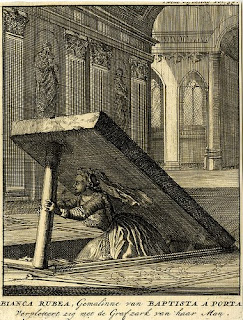
My caution with regards the book started small, there were just the occasional areas that gave me pause for thought and I could actually understand why they occurred. There is an illustration in the introduction, page 12, of “‘a vampire rises from the grave…’in an 18th century illustration” . Actually, not long before receiving the book (as a Christmas present from my ever loving wife) I read an article about this illustration on the blog Diary of an Amateur Vampirologist. It seems the illustration was reproduced in Frayling’s Vampyres: Lord Byron to Count Dracula (listed in the bibliography of this) as such a piece, but it is actually of "BIANCA RUBEA, wife of BAPTISTA Á PORTA / crushes herself with the tombstone of her husband." A minor problem, as it is an illustration of a suicide and not a vampire, but I can see why Beresford believed it to be of a vampire given Frayling used it as such.
I most recently dealt with this erroneously-named picture in "Hats Off to Erwin".

Taliesin also left a comment to said blog, which I'll reply to here:
I am currently reading "From Demons to Dracula" by Matthew Beresford, which so far is quite good - expect a review when read.
As mentioned, I did read it. Loved it. If you're interested, you might want to check out Niels K. Petersen's coverage of it over at Magia Posthuma.

I'm sure I'll get around to obtaining a copy of the book, sometime, myself.
However, the illustration is reproduced in that with the caption "A vampire rises from the grave, from an eighteenth century illustration."
Ah, yes. Nearly the exact same caption it's given in Frayling's book, Vampyres: From Lord Byron to Count Dracula (1991).
It accompanioes the introduction. Now, given Beresford cites Frayling in his bibliography, the place he picked it from is clear but, it seems, this one is likely to run and run...
I'd agree that Frayling's book is the most likely source for the picture's erroneous description. The obvious clue to this is the caption that follows it in Frayling's work: "A vampire rises from the grave, illustrating an early eighteenth century treatise on the undead."

A slightly different wording to that found in Beresford's book, as you've quoted it, but recognisable, nonetheless.

I certainly hope it doesn't catch on as a picture representing an undead rising from the tomb. Though, there is certainly an irony in that description, considering that it actually depicts a woman entombing herself, certainly not rising in search of blood.

So folks, if you see this picture (chances are, with the original caption removed)...


...being referred to as anything even remotely vampiric, then dismiss it as bad research. Indeed, it's not even from the "eighteenth century", but the seventeenth. For, according to the Koninklijke Bibliotheek, the image was published in 1699.

Friday, August 1, 2008

Word Gets Around

It's only been up a couple of days, but word on my blog is already getting 'round.

Niels K. Petersen gives it a brief write-up in
"Blogging: The Living, the Dead, and the Undead" (Magia Posthuma) and Andrew M. Boylan features my blog as an "External Link" on Taliesin Meets the Vampires.

Awesome.

You might remember that I cited both these guys as influences on this blog in my first post, so to get coverage on their respective pages, is truly an honour.
Related Posts with Thumbnails

News