Showing posts with label Andrew M. Boylan. Show all posts

Wednesday, April 6, 2011

Andy Responds!

I'm so glad I cautiously-worded my coverage of certain obscure vampire lore in one of Andy's movie reviews.


We're talking about the nailing-the-vampire-through-the-head thing as a means of 'destroying' an undead. I said that he 'may or may not know' that it had a 'European precedent'. Turns out, he did know (I shoulda known he would). Here's his reply:
Hi Anthony, good article.

I was aware of the European lore - especially via Calmet. I also take the point that the filmmakers were likely looking to European lore rather than anything further flung.

The fault is mine for not explaining what I meant. I was more alluding to an accidental connectivity, perhaps alluding to a subconscious undercurrent.

Why was a stake or a nail used? To pin the undead to the floor primarily (or in Indonesia to strip them of their powers, essentially the same thing).

This would allow for a generally common theme (and possibly sources back to post-mortem sitting of corpses, which I understand is more common than we'd think)

I like such connections and perhaps should have mentioned the, clearly, more obvious European connection.

Re your quote concerning the location of the nail (ie back of the neck), this is a more common entry point (from my researches), but at least one Indonesian films switches things to the crown of the skull. The forehead makes for a more visually immediate scene, when the corpse is coffin bound ;)
All good points and I like that Andy's openly discussing his interest in comparative folklore; a common theme in vampire studies.

Friday, April 1, 2011

Head Like a Hole

An obscure method of destryoing vampires caught my attention in Andrew's review of The night of the walking dead (1977).


Andrew has a great passion for the lore featured in vampire flicks, which always receives coverage in his reviews. I love vampire lore, meself, especially when it's particularly inventive or suggests the filmmakers might've done some actual research for their movie. So, the following paragraph from his review couldn't help but catch my attention:
The other lore we get is the fact that a stake through the heart won’t work permanently. Clearly we saw that and, as Catherine's father is the one who communicates the effective method, we can only guess that he didn’t relay that to the villagers as it was his daughter they were staking. Rather an iron nail should be hammered through the skull – this not only makes for a nicely unusual scene but forms (unintentionally) a bridge between East and West as the Indonesian Kuntilanak is sometimes said to lose its powers through just such an intervention.
An interesting parallel, but I'm somewhat skeptical that the 'bridge between East and West' was a deliberate move. After all, what Andrew may or may not know, is that there's actually a European precedent for this method of destruction. Let's turn to Augustine [sic] Calmet's The phantom world; or, the philosophy of spirits, vol. 2 (London: Richard Bentley, 1850)¹. Calmet relates an account from someone byway of the 'Count de Cabreras, captain of the regiment of Alandetti infantry' who dealt with a vampire infestation 'on the frontiers of Hungary' (p. 33). Three alleged vampires were exhumed, each dealt with in a different way. It's the second sucker we're concerned with here:
Upon this deposition the commissary had this man taken out of his grave, and finding that, like the first, his blood was in a fluid state, like that of a living person, he ordered them to run a large nail into his temple, and then to lay him again in the grave (p. 34).
For the record, the first vampire was beheaded, the third was cremated. Calmet gives no explanation as to why these various methods were employed against these unfortunate undead. The nail-in-the-head routine is later invoked in his coverage of Greek practices against the excommunicated dead:
They know of no means more certain to deliver themselves from being infested by these dangerous apparitions, than to burn and hack to pieces these bodies, which served as instruments of malice, or to tear out their hearts, or to let them putrefy before they are buried, or to cut off their heads, or to pierce their temples with a large nail (p. 109).
For a literary parallel, we turn to an anonymous German story called 'The mysterious stranger', which was first published in English in Odds and ends in 1860:
"You see there that open vault!" replied the knight Woislaw, pointing to the door and flight of steps: "You must descend. You must go alone; I may not accompany you. When you have reached the vault you will find, close to the entrance, a coffin, on which is placed a small packet. Open this packet, and you will find three long iron nails and a hammer. Then pause for a moment; but when I begin to repeat the Credo in a loud voice, knock with all your might, first one nail, then a second, and then a third, into the lid of the coffin, right up to their heads."

Franziska stood thunderstruck; her whole body trembled, and she could not utter a word. Woislaw perceived it.

"Take courage, dear lady!" said he. "Think that you are in the hands of Heaven, and that without the will of your Creator, not a hair can fall from your head. Besides, I repeat, there is no danger."

"Well, then, I will do it," cried Franziska, in some measure regaining courage.

"Whatever you may hear, whatever takes place inside the coffin," continued Woislaw, "must have no effect upon you. Drive the nails well in, without flinching: your work must be finished before my prayer comes to an end."
So, to sum up, I find it much more likely that the filmmakers drew upon extant European use sof nails against the undead. However, I couldn't end this without giving some coverage to the kuntilanak Andrew mentions. Let's turn to our good friend, Wikipedia:
Some believe that having a sharp object like a nail helps them fend off potential attacks by Pontianaks, the nail being used to plunge a hole at the back of the Pontianak's neck. It is believed that this will turn the Pontianak into a beautiful woman, until the nail is pulled off again. The Indonesian twist on this is to plunge the nail into the apex of the head of the kuntilanak.

¹ Rev. Henry Christmas' English translation of Augustin Calmet's Traité sur les apparitions des Esprits, et sur les vampires ou les revenans de Hongrie, de Moravie &c. (1751).

Wednesday, September 1, 2010

The Importance of Paper Trails

I've received an interesting comment from reader, Jonathan, concerning assumptions raised in my previous post. I'll address it here, and also discuss the scholarly value of citing other works.

Peter Haining's A Dictionary of Vampires (London: Robert Hale, 2000) provided a misattributed source on pre-Gerard usage of the term nosferatu. I derived three possibilities from this, namely, 1) Haining misunderstood Jones' ambiguous comment about von Wlislocki's "researches into Roumanian superstitions", 2) Haining obtained the misattributed quote from another dodgy source and 3) Haining fabricated the source. Here's what Jonathan had to say about my conclusions:
Great work. However, I don't think your three possibilities are necessary.

The 1861 date must surely come from a conflation of footnotes on p117 of Jones' 'On The Nightmare'.

There IS an 1861 dated bibliographic reference on that page, but it's to a completely different preceding point.

Have another look at Footnotes 1 (irrelevant to 'Nosferat', dated 1861) and 2 (the Stern quote, undated in Jones' text).

As the two are oddly arranged relative to one another, and Footnote 2 lacks a date, it's easy to see how someone in a rush might attribute that date to the wrong footnote.

Here's what I mean;
http://www.archive.org/stream/onthenightmare032020mbp#page/n119/mode/2up/search/1861
While he raises some intriguing points, I'm gonna stick to my guns on this one. Why? Let's take a look at the footnote in question:


The footnote appears in Ernest Jones' On the Nightmare (London: Hogarth Press, 1931), p. 117. Sure, their placement is a little odd. That's a formatting issue more than anything, but let's cast our eyes further up the same page:


I find it difficult to believe that Haining could have conflated the footnotes so easily. To verify where Wlislocki was being quoted from, all he had to do was comb through the book for other references to Stern, especially as "Quoted by" and "op. cit." were mentioned. I was able to do this easily enough. That's why I can tell you that Jones was quoting Wlislocki via Bernhard Stern's Medizin, Aberglaube und Geschlechtsleben in der Türkei. Mit Berücksichtigung der moslemischen Nachbarländer und der ehemaligen Vasallenstaaten, Vol. 1 (Berlin: H. Barsdorf, 1903).

While I do see Jonathan's point about the 1861 date, there's two other aspects of Haining's misattributed citation that aren't so easily dismissed. Firstly, Haining attributes an actual book title to Wlislocki, that is Roumanian Superstitions (1861). As I'd pointed out, no such book is quoted in the text. Instead, Jones makes reference to Wlislocki's "researches into Roumanian superstitions", which is where I suspect Haining derived the imaginary title from.

Secondly, it's clear that Haining either altered Jones' translation of the Wlislocki extract or derived it from another, faulty source. Compare the two sources. In Jones' rendering, we have "The Nosferat not only sucks the blood of sleeping people, but also does mischief as an Incubus or Succubus" (117), meanwhile, Haining's "quote" says "The Nosferatu not only sucks the blood of sleeping people, but also does mischief as an Incubus or Succubus" (184). There's small differences between the two, but they're significant in proving that an alteration has taken place.

So, to sum up, Haining doesn't get off the hook that easily. Using Jones' footnotes as evidence, Haining had no justification in concocting an imaginary book title (like we need more of those). In this regard, he was sloppy at best and outright deceptive at worst. If Haining's book had featured a bibliography, it would be much easier to establish which of these possibilities was most likely.

This is why paper trails are essential. Quotations, citations, footnotes, they're all-important for verifying the accuracy of information conveyed and sources consulted. It's also perfectly demonstrated in Andrew's review of Charlotte Montague's Vampires: From Dracula to Twilight: The Complete Guide to Vampire Mythology (2010), a book I'd previously regarded with a glimmer of hope, in light of its author's MA degree for History.

Yet, here's what Andrew has to say about the book's coverage of the historical origins of the vampire's destruction by sunlight:
The moniker “From Dracula to Twilight” is a misnomer as it does explore (though explore is perhaps a generous term) things that came before Dracula. When it comes to sources I would have loved to have seen one for the assertion that (having first neglected to mention Nosferatu when exploring the sunlight myth) in “later stories, vampires might collapse or explode when hit by sunlight, the ‘scientific’ explanation for this being that their neural pathways would fire randomly in their brains, causing them to experience extreme epileptic reactions, blinding them, and possibly setting them on fire”! I have seen many an explanation as to why sunlight might affect a vampire, and countless more films and books when it isn’t even explained but simply taken as read. I do not recall a theorem such as that… pray tell me your source… the book remains silent.
This is an incredibly disappoining for the scholarly reader: a dead-end. How do we verify such information? Where do we even begin to start? What are we to make of its publisher, Sphere, and their claim that they pride themselves on "publishing high-quality commercial fiction and non-fiction" and their "[p]assion, imagination and attention to detail are the cornerstones of our publishing"? It's a hell of an oversight.

Sure, footnotes and citations aren't the most aesthetically pleasing things, but they're integral for scholarly readers and further research, especially when it comes to such extravagant claims. It also applies to images, too. I've previously covered an erroneous caption and its relevance to vampire research, as well as its reproduction in another source. You see, without keeping dodgy info in "check" it tends to spread. This is detrimental to proper study of the genre and should be avoided at all cost. If in doubt, consult the primary source.

Thursday, July 15, 2010

More Sugar for Kane

I gave some coverage to Tim Kane's The Changing Vampire of Film and Television: A Critical Study of the Growth of a Genre (2006) here, but Andrew's recently given it a much more thorough review. Check it out.

We both enjoyed the book, as you'll see by his rating, even if we disagree on a few minor points.

Friday, May 14, 2010

Review Reviewed

Andrew's awesome review of Mark Collins Jenkins' Vampire Forensics: Uncovering the Origins of an Enduring Legend (2010) makes some very valid points about my own take on the book:
Friend of the blog, Anthony Hogg, has mentioned this book at his blog and, whilst his opinion of it improved, at first he lamented the fact that the book seems to stroll through the same old areas of investigation. However, the difference between myself and Anthony is that my study of the genre has been more media orientated, whilst he has a strong background in examining the folklore/traditional aspects of the genre. As such I found the opening of the book to be a well written refresher on things I had read before and certainly a useful source for those starting their exploration of the myths behind the media.
I freely admit to being more into the folklore/historical angle of vampires. That's one of the reasons I get a big kick out of Niels' blog. Andrew's comment highlights the different approaches/levels of interest found in the field. In terms I vampirology, I've covered different approaches elsewhere.

The beauty of vampire study, is that they're so damn varied. As I've previously pointed out (byway of David Lavery) Buffy Studies, alone, has about fifty "disciplines, methods, and/or approaches". That's right: fifty. I can never get over that figure.

So, even though I'll occasionally lament that there just aren't enough books written on the historical/folkloric angle, I'll never say that they're the only angle that should be taken. We all have our own biases, after all. And the vampire, as a figure of study, exists beyond such a narrow template.

That said, I still stand by my comments on Jenkins' book. The majority of books on vampires take the expansive backdrop of the Vampire and paint on the same canvas. Yes, we Count Dracula was (partly) based on Vlad. Yeah, Polidori satirised Byron for The Vampyre. The Paole case kick-started interest in vampires in Western Europe? Ok, we got it. And gee whiz, aren't certain spirits, gods and monsters of other cultures awfully similar to vampires? Heard it before.

Give me something new. Something different. Discuss areas not usually covered by the multitude of other writers out there! That's why I find myself increasingly drawn to the obscure stuff.

When I pick up a book like Vampire Forensics, I expect it to do what it says on the tin: give me a detailed analysis of the vampire myth. Concentrate on the specific writings, places, belief systems where this manifested. I don't need a transcendent stroll through the mythologies and burial practices of other cultures. If I wanted that, I could read Summers. And have.

Give me vampires!

Keep in mind, I'm not saying Jenkins wrote a bad book. It's actually quite good in its own right. My frustration stems from being waylaid by its title. Maybe my bias is too strong. Regardless, I don't think there's much justification in giving such minor coverage to the actual vampire itself. And by "actual", yes, I mean the one of folklore and history. I know this flies in the face of the what-is-a-vampire question I left open-ended, but come on, give me a break.

Without the vampire of these dark regions, there would be none of the fictional literature and flicks lapped up by so many. There would be no vampire subculture. No fandom. Nothing. All I ask is that it be given a little more prominence; especially in a book examining "forensics". End rant.

Wednesday, May 12, 2010

Sneaky Props

Andrew's screencap (Fig. 1) of a prop in his review of Mystery and Imagination: Dracula (1968) drew my attention:


Fig. 1 Andrew's screencap.

It's a woodcut rendering of Denholm Elliott's Dracula character, which caught my eye for two reasons. Firstly, I've seen that image before. Well, not the version used in the film (more on that, shortly). Second, it tied in with Andrew's comments about the movie's emphasis on sexuality: "If Stoker hinted at a sexual aspect to vampirism then this production screamed it".

So, what's the link between the two?

The image this phony woodcut is based on, originally depicted an incubus. Don't know what an incubus is? Here's a definition: ". . . a demon in male form supposed to lie upon sleepers, especially women, in order to have sexual intercourse with them, according to a number of mythological and legendary traditions."

Thanks to the magic of Google, I've been able to trace the original pic for your viewing pleasure. Here tis (Fig. 2):


Fig. 2 "Male devil embracing woman".

The page's source lists Ulrich Molitor's De Lamiis et Pythonicis Mulieribus ("Of Witches and Diviner Women"). According to Erika Mailmain, this book was first published in 1493 (despite her source listing 1489). She adds that the ". . . book went into several editions, illustrated by woodcuts that were updated so it is possible to find different versions of the same image." That certainly explains why I've seen variations of the same woodcut. Here's a minor variation (Fig. 3):


Fig. 3 "incisione da De lamiis et pythonicis mulieribus di Ulrich Molitor, Colonia, 1489".

And then there's others barely recognisable from the source, except for the same motifs. Like this one, from the c. 1498 Köln [Cologne] edition (Fig. 4):


Fig. 4 Illustration 4.

I highly doubt the production designers consulted the original editions (due to their scarcity) for inspiration, so my guess is they came across the image in a book on witchcraft. Say, for instance Rossell Hope Robbins' The Encyclopedia of Witchcraft and Demonology (New York: Crown Publishers, Inc., 1959). On page 465, a reproduction of an image closely resembling Fig. 3 appears. The entry it's incorporated to? "Sexual Relations with Devils".

Monday, February 1, 2010

Not Tieck's Vampire

I was inspired to write this entry by Andrew's latest movie review.

"Wake Not the Dead" (c. 1800) is a short story commonly attributed to German Romanticist, Johann Ludwig Tieck (1773 - 1853). Its importance to the genre is enhanced by the fact that it preceded John Polidori's "The Vampyre" (1819) by nearly 20 years.

Or so we thought.

Recent studies have revealed that Tieck wasn't actually the author of the story. That credit is now going to Ernst Benjamin Salomo Raupach (1784-1852).

I'm not sure if Rob Brautigam, a Dutch vampirologist, was the first to uncover this point of attribution, but his comment on the matter was certainly the first reference I've seen (it was incorporated to this review).

The attribution is also elaborated in "Relato Gotico/Vampirismo: Deja a los Muertos en Paz - Avances Programa Nº 425 (21/11/09)" (English translation here) and Heide Crawford has composed a paper for the 2010 Kentucky Foreign Language Conference.

As she and the other articles reveal, not only was Tieck not the author of the story, but it was actually first published in 1823.

Here's what she has to say on the matter, also revealing a possible source of the error:
When Theodor Hildebrandt published the first German vampire novel Der Vampir oder die Todtenbraut in 1828, he was contributing to a long tradition of literary representations of the vampire in European poetry and prose that began with Heinrich August Ossenfelder's poem "Der Vampir" in 1748. Two years before Hildebrandt published his vampire novel, the popular dramatist Ernst Benjamin Salomo Raupach (1784-1852) had published the vampire story "Lasst die Todten ruhen" (1823), which has been erroneously attributed to Ludwig Tieck by American and British scholars of Gothic Horror literature since at least 1973 when Peter Haining published the English translation, "Wake Not the Dead" in his volume two of his Gothic Horror anthology Gothic Tales of Terror and named Tieck as the author.
I should note that "Relato" cites Popular Tales and Romances of the Northern Nations (1823) as the source of the error.

But, Tieck does have a saving grace: Crawford attributes the "earliest known German prose work that features a female vampire" to him, in the shape of his 1812 story, "Liebeszauber".

And thus, Tieck's place in the vampire genre is still solid. Even if it's for a completely different story.

Thursday, January 14, 2010

More on Vampire Apocalypses

A recent addition to the vampire apocalypse genre is Daybreakers (2009), set in an alternate future in which the vampires have taken over and enslaved the remnants of humanity as a food source.

Andrew's written a great little review of the film.

Its premise is slightly reminiscent of an episode of Buffy the Vampire Slayer called "The Wish", which, in turn, echoes a plot device used in Blade (1998).

However, the blood-farming motif had already been used as far back as 1979, in Rod Hardy's Thirst.

As a general entry into the Vampire Apocalypse genre, I should also mention E. E. Knight's "Vampire Earth" series (2003- ), which chronicles humanity's subjugation by a race of extraterrestrials called Kurians, who prolong their lifespans by draining people of their "vital aura".

Tuesday, November 3, 2009

Everything Old Is New Again

Andrew recently wrote a review for Weird Vampire Tales (1992) after I recommended it to him, a little while ago.

It seems he enjoyed the anthology of pulp fiction vampire stories as much as I did.

However, his description of the stories all being taken from Weird Tales is slightly inaccurate: most of them were. But not all. This site shows which story came from which magazine.

Andrew's review also notes a couple of (now) standard vampire tropes, which may originally have been published in the pulps. For example:
In a visual medium, as far as I know, it was Dan Curtis who brought the concept of the reincarnated love into the vampire genre as a main theme in Dark Shadows. I, the Vampire by Henry Kutner is a much earlier written example of the concept being used – dating back to 1937.
And "William Tenn uses science, and a blood substitute, to enable vampires and humans to coexist, long before True Blood, in She Only Goes Out at Night."

Tuesday, January 20, 2009

Remake Canned?

I was quite glad to read coverage concerning the proposed Fright Night (1985) remake been given the flick over at Brian Solomon's The Vault of Horror.

What a relief.

I previously had a brief discussion (see comments) on the proposed remake at Taliesin Meets the Vampires. Not only do I treasure the original movie (its sequel was very influential to my interest in vampires) I'm sick and tired of remakes, in general.

That's not to say I don't enjoy them here and there. Off the top of my head, I'd include The Thing (1982), The Texas Chainsaw Massacre (2003), Dawn of the Dead (2004) and Halloween (2007) as examples which were carried off quite nicely.

But, seriously, what's the point? Solomon provides an interesting overview of the subject in "Horror Remakes: Then vs Now".

I used to joke about the inevitability of a Gone with the Wind (1939) remake...but at the rate remakes are being churned out these days, it might be a bit more feasible than I first thought.

Thursday, January 8, 2009

Frayling's "Vampire" Makes Another Appearance

I've just read Taliesin's "From Demons to Dracula - review", which cites this very blog:
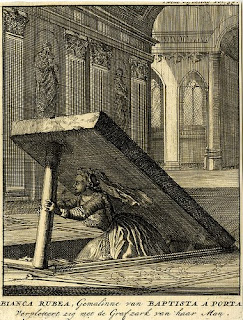
My caution with regards the book started small, there were just the occasional areas that gave me pause for thought and I could actually understand why they occurred. There is an illustration in the introduction, page 12, of “‘a vampire rises from the grave…’in an 18th century illustration” . Actually, not long before receiving the book (as a Christmas present from my ever loving wife) I read an article about this illustration on the blog Diary of an Amateur Vampirologist. It seems the illustration was reproduced in Frayling’s Vampyres: Lord Byron to Count Dracula (listed in the bibliography of this) as such a piece, but it is actually of "BIANCA RUBEA, wife of BAPTISTA Á PORTA / crushes herself with the tombstone of her husband." A minor problem, as it is an illustration of a suicide and not a vampire, but I can see why Beresford believed it to be of a vampire given Frayling used it as such.
I most recently dealt with this erroneously-named picture in "Hats Off to Erwin".

Taliesin also left a comment to said blog, which I'll reply to here:
I am currently reading "From Demons to Dracula" by Matthew Beresford, which so far is quite good - expect a review when read.
As mentioned, I did read it. Loved it. If you're interested, you might want to check out Niels K. Petersen's coverage of it over at Magia Posthuma.

I'm sure I'll get around to obtaining a copy of the book, sometime, myself.
However, the illustration is reproduced in that with the caption "A vampire rises from the grave, from an eighteenth century illustration."
Ah, yes. Nearly the exact same caption it's given in Frayling's book, Vampyres: From Lord Byron to Count Dracula (1991).
It accompanioes the introduction. Now, given Beresford cites Frayling in his bibliography, the place he picked it from is clear but, it seems, this one is likely to run and run...
I'd agree that Frayling's book is the most likely source for the picture's erroneous description. The obvious clue to this is the caption that follows it in Frayling's work: "A vampire rises from the grave, illustrating an early eighteenth century treatise on the undead."

A slightly different wording to that found in Beresford's book, as you've quoted it, but recognisable, nonetheless.

I certainly hope it doesn't catch on as a picture representing an undead rising from the tomb. Though, there is certainly an irony in that description, considering that it actually depicts a woman entombing herself, certainly not rising in search of blood.

So folks, if you see this picture (chances are, with the original caption removed)...


...being referred to as anything even remotely vampiric, then dismiss it as bad research. Indeed, it's not even from the "eighteenth century", but the seventeenth. For, according to the Koninklijke Bibliotheek, the image was published in 1699.

Friday, August 1, 2008

Word Gets Around

It's only been up a couple of days, but word on my blog is already getting 'round.

Niels K. Petersen gives it a brief write-up in
"Blogging: The Living, the Dead, and the Undead" (Magia Posthuma) and Andrew M. Boylan features my blog as an "External Link" on Taliesin Meets the Vampires.

Awesome.

You might remember that I cited both these guys as influences on this blog in my first post, so to get coverage on their respective pages, is truly an honour.

Wednesday, July 30, 2008

No Need for Clicks

My previous entry gave mention to Andrew M. Boylan's blog, Taliesin Meets the Vampires.

But did you know it's also available in hardcopy?

Andrew broke the news in "Taliesin Meets the Vampires - Volume 1":

The blog as a book! Announcing the collected words from the blog, spanning the period March 5th 2006 up until 20th January 2007.

It's currently selling for US $29.02 from Lulu. Do yourself a favour, and buy a copy today!

Just a Quick One

Welcome to the inaugural "diary" entry of an amateur vampirologist!

I'll go into that title a bit more, at a later time.

But for now, I can tell you that the purpose of this blog is to share my thoughts and resources on things vampiric. It was largely inspired by Niels K. Petersen's brilliant Magia Posthuma, Andrew M. Boylan's comprehensive Taliesin Meets the Vampires, Curt Purcell's wonderful The Groovy Age of Horror and the layout of The Mystery of the Haunted Vampire.

I highly recommend you give each one a read.
Related Posts with Thumbnails

News